

Bottega Veneta: Six Decades of the Woven Bag
When Michele Taddei and Renzo Zengiaro opened their workshop in Vicenza in 1966, the challenge was practical rather than artistic: the local sewing machines were better suited to fine materials than thick leather. Working with supple hides and interlacing narrow strips by hand helped establish intrecciato, the woven pattern that has identified the house ever since without needing to spell out its name. The slogan “When your own initials are enough” captured that approach: a bag recognisable through construction rather than a monogram.
Six decades on, successive creative directors have found different possibilities within the weave. Some have preserved its close, regular proportions; others have enlarged it, loosened it or used it to give familiar shapes an unexpected volume. Pieces appearing at Sotheby’s offer a way of tracing those changes through the objects themselves.
The Cabat and the Hobo
Under Tomas Maier, the Cabat became one of the clearest expressions of the house’s craft. Its open tote shape gave woven leather room to stand on its own, with little to distract from the relationship between the strips, handles and body. Making one requires days of skilled handwork, despite the apparent simplicity of the finished bag.
Four Cabats appeared together in a 2020 Sotheby’s Geneva sale, in pewter, black, lime green and brown, each estimated in the low thousands of Swiss francs. Seen side by side, they demonstrated how much colour could change the character of the same construction. A black-and-crystal PVC Cabat GM from 2012 took the idea further, translating the familiar woven form into a markedly different material.
Alongside the Cabat, the Veneta offered a softer, slouchier shape. Its curved body and shoulder strap made the weave part of an easy, everyday silhouette, rather than the broad surface of an open tote. A Desert Rose Veneta in intrecciato nappa, with brass hardware, has also appeared in Sotheby’s handbag catalogue. Between them, the two designs established much of the vocabulary that later creative directors would reconsider.
Daniel Lee and a Change of Proportion
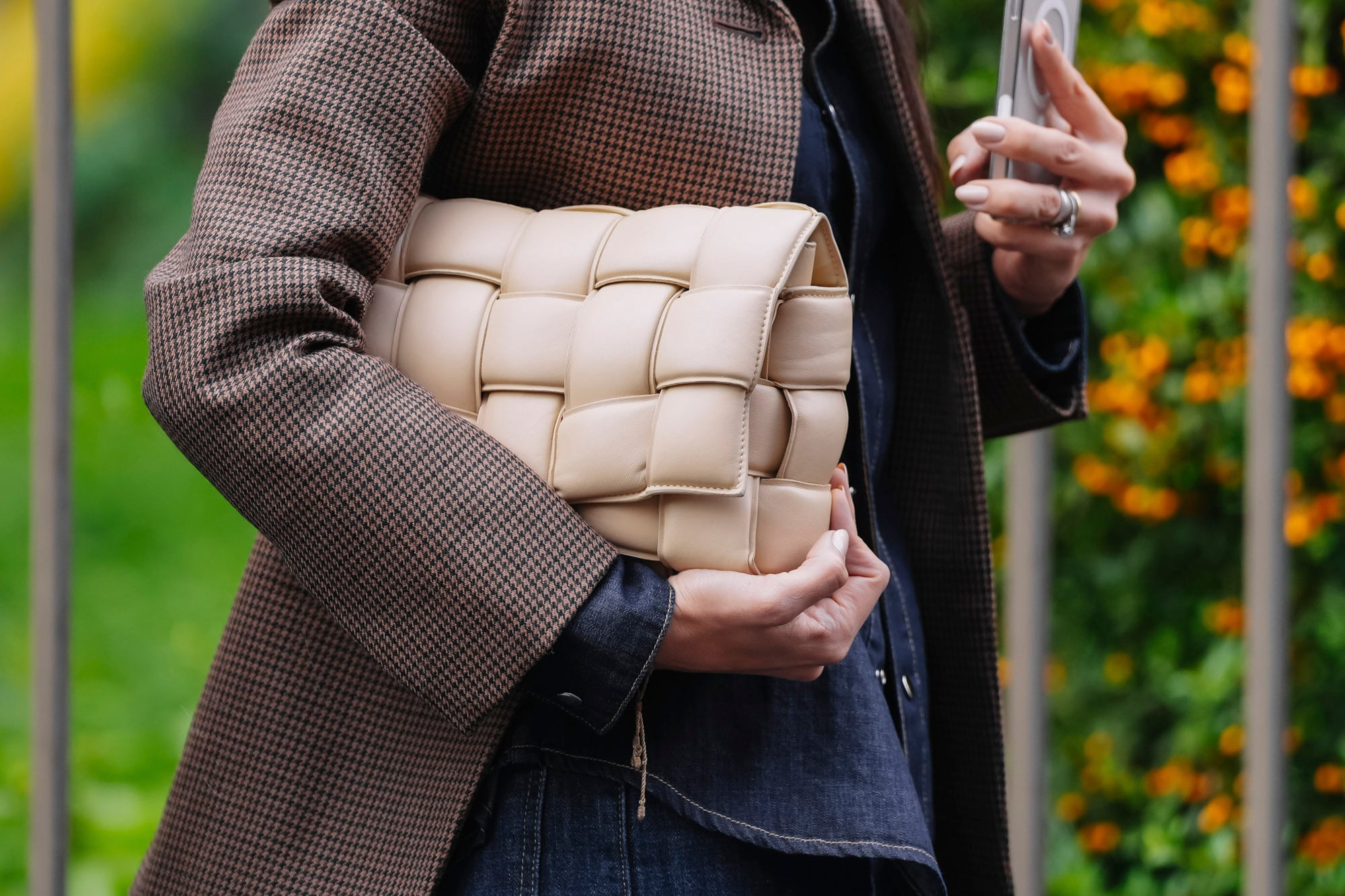
Daniel Lee’s arrival in 2018 brought a more pronounced shift in scale. The Pouch gathered soft leather into an oversized clutch, while the Cassette enlarged the weave until its individual sections became the dominant feature. The Jodie, meanwhile, gave the curved shoulder bag a distinctive knotted handle.
These were different ways of making a bag recognisable at a glance. The Pouch relied on volume, the Cassette on exaggerated construction and the Jodie on a single detail placed where the hand meets the bag. Brighter colours and more assertive proportions broadened the house’s visual range while retaining leather as the principal means of expression.
Lee’s designs became prominent in contemporary fashion imagery, including the styling surrounding a Net-a-Porter holiday edit for Sotheby’s Luxury Week in New York. Their presence there reflected how readily the bags had entered a wider wardrobe, alongside jewellery and other luxury objects.
Blazy’s Craft Experiments
Matthieu Blazy, who took over in 2021 before leaving for Chanel at the end of 2024, explored what the leather itself could do. The Kalimero, introduced in 2022, used the foulard intreccio technique to create a bucket-shaped bag with a continuous woven construction. Its rope-like elements gave the surface a different rhythm from the close, regular weave associated with earlier designs.
The Andiamo, introduced the following year, brought a more structured shape into the collection. A top handle and adjustable strap offered different ways of carrying it, while a metal knot became a recognisable point of detail. Where the Kalimero drew attention to the ingenuity of its construction, the Andiamo placed that craftsmanship within a more familiar daily routine.
Blazy’s contribution was to make technique part of the design’s interest. The bags invited closer inspection, with the handling of the leather explaining as much as the outline.
Louise Trotter and the Original Scale
Louise Trotter’s debut collection in September 2025 returned to the proportions of the archive. For Spring/Summer 2026, intrecciato appeared in nine- and twelve-millimetre widths, restoring a finer scale after several seasons in which enlarged weaving had become especially recognisable.
The technique also extended beyond handbags into the collection’s clothing. This gave the weave a broader role, linking accessories and garments through their construction rather than a repeated emblem.
Trotter has described the joining of separate strips as a metaphor for collaboration: individual elements gaining strength through their connection. In Bottega Veneta’s sixtieth-anniversary year, that interpretation brought renewed attention to the people and processes behind a familiar surface.
Recognising the Handwork
For a collector, the differences between these bags reward attention. A Cabat’s broad woven body, a Veneta’s curved profile and a Cassette’s enlarged strips each reveal a particular approach to proportion. Material matters just as much: supple nappa and crystal-adorned PVC can produce very different objects from a related construction.
The interest lies in following those decisions through individual pieces. A familiar weave can identify the house immediately, yet its scale, finish and handling reveal the period in which a bag was made. That combination of continuity and variation gives Bottega Veneta’s bags their place in a collection, with enough in common to belong together and enough distinction to merit a closer look.
Read More