

What Home Features are on a Dubai Luxury Buyer's Checklist?
Dubai's ultra-luxury property market has moved well past the era when a sweeping view, a marble lobby and a private pool were enough to impress. Today's most demanding buyers are asking for requirements that have a higher degree of specificity: homes engineered around their daily habits, their cultural traditions and, in some cases, their car collections.
According to Chris Whitehead, Managing Partner at Dubai Sotheby's International Realty, the shift is fundamental. At the top of the market, buyers are no longer simply comparing square footage and postcodes. The finish of a build, and the particular requests a buyer makes during the design process, tend to say more about what actually motivates the purchase than any brochure ever could.
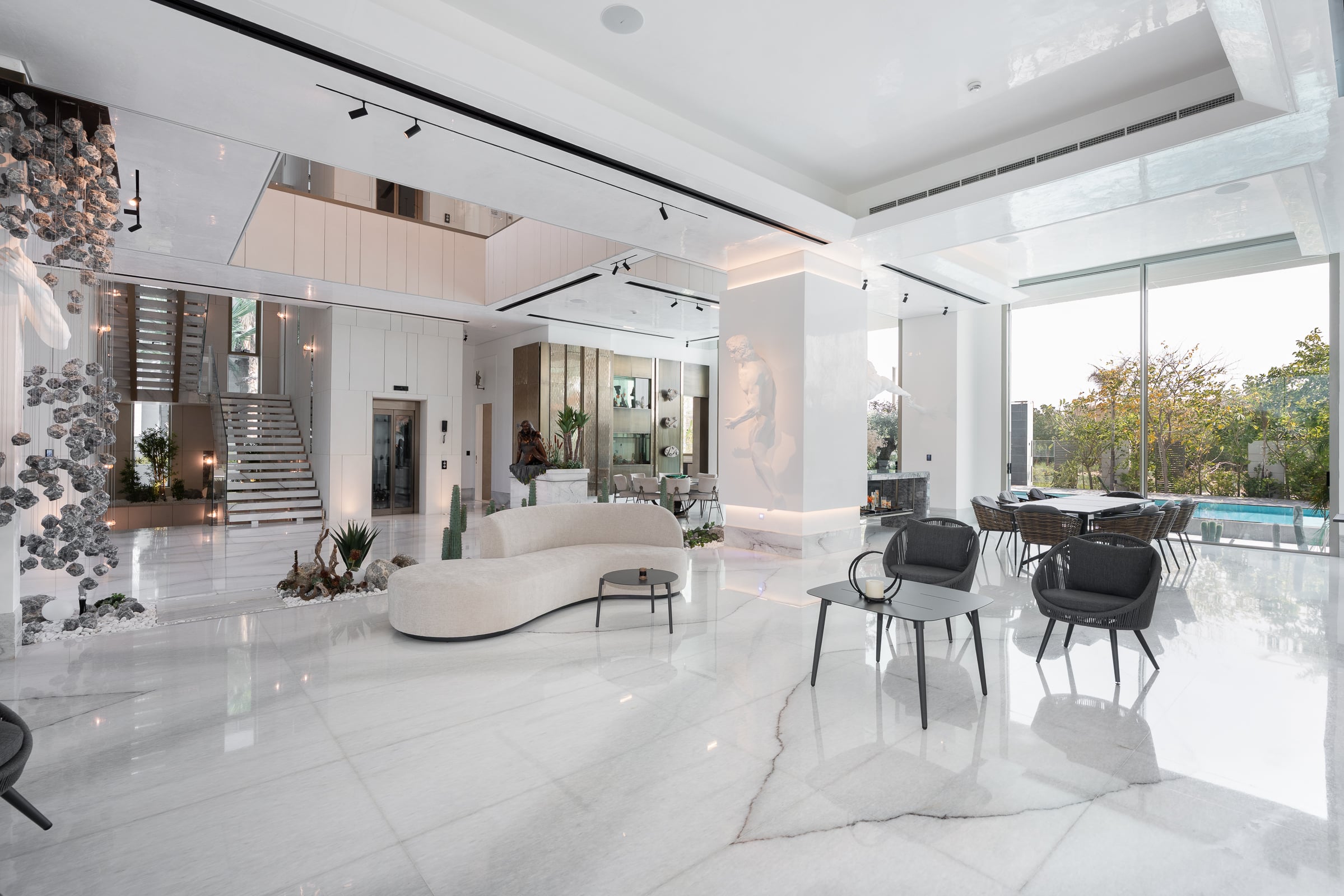
Space, storage and security
Some of the clearest signals come from the basics that wealthy buyers now consider non-negotiable. Whitehead notes that those with substantial wealth are drawn to homes that feel more expansive, whether through generous outdoor areas or basement space.
Dressing rooms tell a similar story. Requests for bespoke fitted storage, built specifically around a client's wardrobe and belongings, come up again and again. These are not the kind of details that make it into a standard marketing deck, but they are exactly the sort of thing that gets built into a custom home from the ground up. The same logic extends to security: concealed safes and biometric entry systems, whether fingerprint, facial or iris recognition, have become standard requests rather than novelties.
Culture as a design principle
Dubai's pull for global wealth is not just about lifestyle in the abstract. Whitehead points out that the emirate offers something more distinctive than many comparable cities, which is part of why it continues to draw buyers from such a wide range of backgrounds. What follows from that diversity is a design brief shaped heavily by culture.
A significant share of luxury buyers come from India and East Asia, and many want their homes to reflect specific traditions. As Whitehead explains, a considerable number of these buyers, who account for a large share of the luxury segment, want their homes to follow Vastu principles. Vastu, the ancient Indian system for aligning buildings with natural and cosmic forces, governs everything from room orientation to material choice, with the aim of drawing in positive energy, health and prosperity.
Feng Shui plays a comparable role for many Chinese buyers, guiding decisions on how a property is oriented, how energy is understood to flow from the main entrance, and even the quality of interior finishes chosen. Whitehead says his firm manages a number of bespoke properties in communities such as Emirates Hills and Dubai Hills Estate, where attentiveness to these principles has proven to be one of the most compelling factors for buyers seeking something exceptional.
It is not only Vastu and Feng Shui shaping the brief. For many Arab families, a majlis designed to properly accommodate large gatherings is just as essential, reflecting the same instinct: a home should resonate with a family's lifestyle and values, not just its budget.
From holiday home to permanent address
Perhaps the most consequential change Whitehead identifies is not aesthetic but structural. A decade ago, most high-end buyers treated Dubai property as a seasonal retreat or a short-term investment: something to hold briefly, perhaps renovate to build value, and resell for profit. That has changed markedly over the past five years, with the majority of buyers now settling in Dubai as their primary residence and long-term home.
That shift changes the entire brief. Once a property becomes a full-time residence rather than an occasional one, the infrastructure and service expectations change with it. Owners pay more attention to how a home will actually function day to day, which puts genuinely bespoke amenities, privacy and spaces tailored to personal interests at the centre of the decision.
Case studies in ambition
Two Dubai Sotheby's International Realty listings illustrate exactly how far this can go. An ultra-luxurious palace in Umm Suqeim, designed by Victor Udzinia, pairs museum-quality interiors with an underground car showroom reached by a dedicated vehicle lift. This is not a garage in any conventional sense: it is a private car museum, climate-controlled, clad in travertine, and connected directly to an indoor entertainment space.
A second property, a SAOTA-designed villa in Umm Al Sheif, dedicates an entire independent floor to wellness, complete with an underground yoga room, a private hair studio, a steam room and a small indoor pool. That floor connects to its own underground car showroom, while the outdoor garden and pool area are built to feel like a resort in miniature.
Whitehead is direct about what ties these examples together. As he puts it, professional-grade spa facilities, private gyms and advanced smart home systems now sit among the top priorities for luxury buyers, and the firm's Jumeirah Bay Island and Emirates Hills properties are built to meet exactly that demand.
The new definition of luxury
What emerges from all of this is a market where the old markers of prestige, size, view, finish, still matter, but no longer decide the sale on their own. The buyers shaping Dubai's ultra-prime segment today are looking for homes that mirror their actual lives: their routines, their traditions, their collections and their sense of what comfort really means. For a market built on ambition, that is arguably the most ambitious standard yet.
Read More