

Dubai’s New Central Park: A Green Landmark for the City’s Next Chapter
Dubai has long been understood through height. Towers, hotels, waterfronts and ambitious skylines have shaped the way the city is seen from afar. Yet its next phase is increasingly being measured closer to the ground, through shaded paths, cycling tracks, family lawns and public spaces designed for the ordinary rhythms of daily life.
At Wasl Gate in Jebel Ali, this shift has taken a substantial new form. Central Park at Wasl Gate, launched by Wasl Group in April 2026, spans approximately 82,700 square metres and has been designed as a shared outdoor space for residents and the wider public. It is one of the largest parks integrated within a residential community in Dubai, giving the southern side of the city a new green landmark with a distinctly civic purpose.
For a city often associated with private luxury, Central Park at Wasl Gate offers something more understated. It is a landscaped space with a practical social purpose, shaped around morning walks, family time, weekend gatherings and the small everyday encounters that give a neighbourhood its character.
In this guide, we explore what Dubai’s new Central Park brings to Wasl Gate, how it fits into Jebel Ali’s wider transformation and why green space is becoming one of the city’s most important measures of liveability.
The Setting
Central Park at Wasl Gate sits in Jebel Ali, within Wasl Group’s master-planned community on the southern side of Dubai. Its location gives the park a different character from the city’s more central green spaces. Rather than serving only as a leisure attraction, it is designed as part of a growing residential district, where outdoor space, retail, dining and community facilities are brought closer to everyday life.
Wasl Gate itself combines apartments, townhouses, shops, restaurants and community amenities, with Festival Plaza Mall by Al-Futtaim adding a practical retail anchor through names such as IKEA and ACE. This gives the district the foundations of a complete neighbourhood rather than a purely residential address.
For Jebel Ali, the park marks an important shift. The area has long been associated with movement, trade and expansion, but Wasl Gate gives it a more residential rhythm. Central Park strengthens that identity, turning the district from a place defined mainly by access and infrastructure into one with a clearer community heart.
Explore Central Park at Wasl Gate
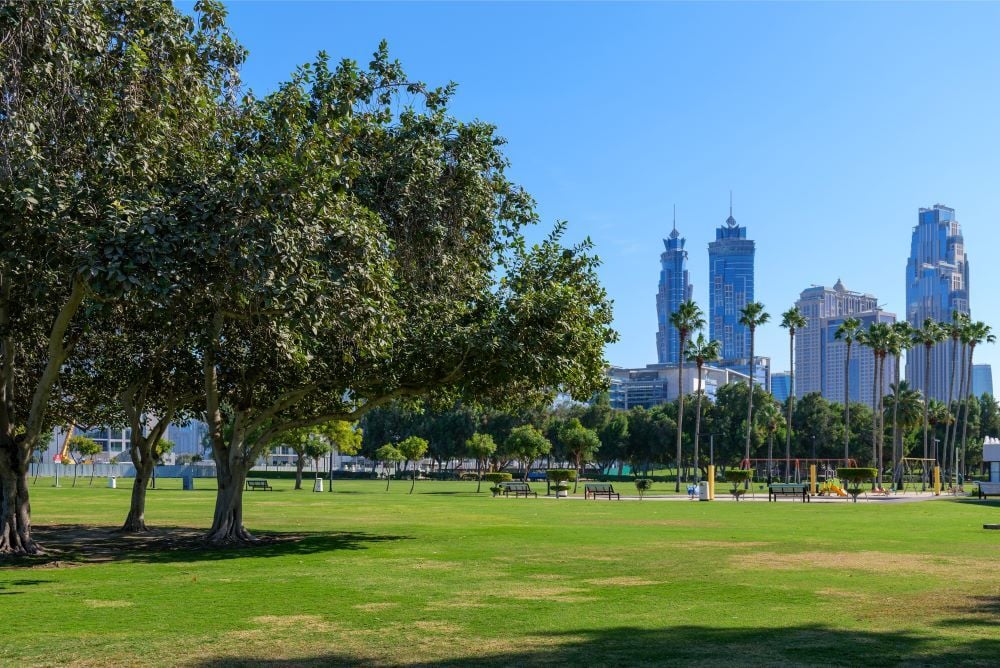
Central Park at Wasl Gate has been designed around both activity and pause. Its facilities include jogging and cycling tracks, sports courts, a skate park, picnic areas, an amphitheatre lawn and a dedicated food truck area. Rather than functioning as a decorative green strip, it has the scale and programme of a proper outdoor destination.
The appeal lies in how naturally these elements support everyday life. A resident can begin the day with a run, children can cycle close to home, families can gather on the lawns, and evenings can unfold around food trucks and open-air seating. It gives the community a rhythm that cannot be created by buildings alone.
There is a quiet sophistication in this kind of urban planning. Its value lies in the ease it brings to daily life, from a morning walk to a casual conversation with neighbours or an unplanned hour outdoors close to home.
A New Centre for Jebel Ali
Central Park gives Wasl Gate a stronger sense of identity. Many new communities are built around residential clusters, retail podiums or road networks, but parks have a different effect. They create memory. They give residents a reason to return to the same place, at different times of day, across different stages of family life.
For Jebel Ali, this is particularly important. The district sits on one of Dubai’s major growth corridors and has the advantage of connectivity, scale and long-term development potential. Yet liveability depends on softer infrastructure too: shade, green space, walkability, play areas and places where the community can gather without formality.
Central Park adds that missing emotional layer. It gives Wasl Gate a place that feels less transactional and more settled. Over time, it may become the part of the community by which residents orient themselves, much as historic parks in older cities become shorthand for the neighbourhoods around them.
Why Green Space Matters
The value of a major park is rarely limited to leisure. In cities with strong neighbourhood identities, green spaces often become part of how people understand an address. They offer shade, movement, routine and a sense of pause that buildings alone cannot provide.
Dubai is increasingly developing this kind of urban approach. New communities are no longer judged only by their apartments, roads or retail centres, but by how easily residents can move through them, how comfortably families can spend time outdoors and whether daily life has places to gather beyond the home.
Central Park at Wasl Gate brings that quality to Jebel Ali. It gives the district a green centre and a stronger sense of continuity, allowing the community to feel more settled and complete. Its importance lies not in making Jebel Ali resemble the city’s more established prime districts, but in giving this part of Dubai a clearer residential rhythm, one shaped by open space, movement and everyday life.
Part of Dubai’s Wider Green Shift
Central Park at Wasl Gate also sits within a wider change taking place across Dubai. The city’s parks are no longer being treated only as weekend destinations or landscaped additions to new developments. Increasingly, they are becoming part of the everyday structure of neighbourhood life.
In 2026, Dubai Municipality announced plans to deliver 35 new parks across the emirate, adding more than 340,000 square metres of public and community space across 23 residential areas, with an investment of AED 348 million. The scale of that programme gives context to what is happening at Wasl Gate. Green space is being drawn closer to where people live, rather than reserved for the occasional family outing.
This direction is closely tied to the Dubai Parks and Greenery Strategy and the Dubai 2040 Urban Master Plan, both of which place greater emphasis on wellbeing, public space and the quality of daily life. Seen in that light, Central Park at Wasl Gate is not an isolated opening. It belongs to a larger civic rhythm, one in which Dubai’s future is being shaped not only by towers and roads, but by lawns, shaded paths, play areas and the simple ability to spend more time outdoors.
A Note on the Name
Dubai already has another Central Park, and the distinction is worth making. Central Park at City Walk is a Meraas residential community in Al Wasl, close to City Walk, Downtown Dubai and Jumeirah. Central Park at Wasl Gate, by contrast, is the newly opened public green space within Wasl Group’s Jebel Ali community.
The difference is not only geographic. One belongs to a more central residential address shaped around private parkfront living, while the other gives an emerging district a public green centre. Together, they show how greenery is becoming part of Dubai’s urban language, from established lifestyle neighbourhoods to newer communities still defining their identity.