

A Season of South Asian Modernism at Sotheby's London
On 29 September, Sotheby's London turns its attention to South Asia with a sale devoted to the region's modern and contemporary art. The auction gathers paintings, sculpture and works on paper by artists whose careers, taken together, chart the emergence and evolution of South Asian modernism across the twentieth century and beyond. It is a sale built as much around scholarship as around market appeal, assembling works that have, in several cases, not been seen publicly for decades.
The roster reads as a survey of the movement's defining names: Maqbool Fida Husain, Bhupen Khakhar, Francis Newton Souza, Sayed Haider Raza and Vasudeo S. Gaitonde sit alongside Rabindranath Tagore, George Keyt, Meera Mukherjee, Zarina and Zahoor ul Akhlaq, spanning several generations and a wide range of artistic concerns. Together, they represent the principal currents that shaped art across the Indian subcontinent and its diaspora, from the earliest stirrings of modernism in the 1920s through to the experimental practices that emerged in its final decades.
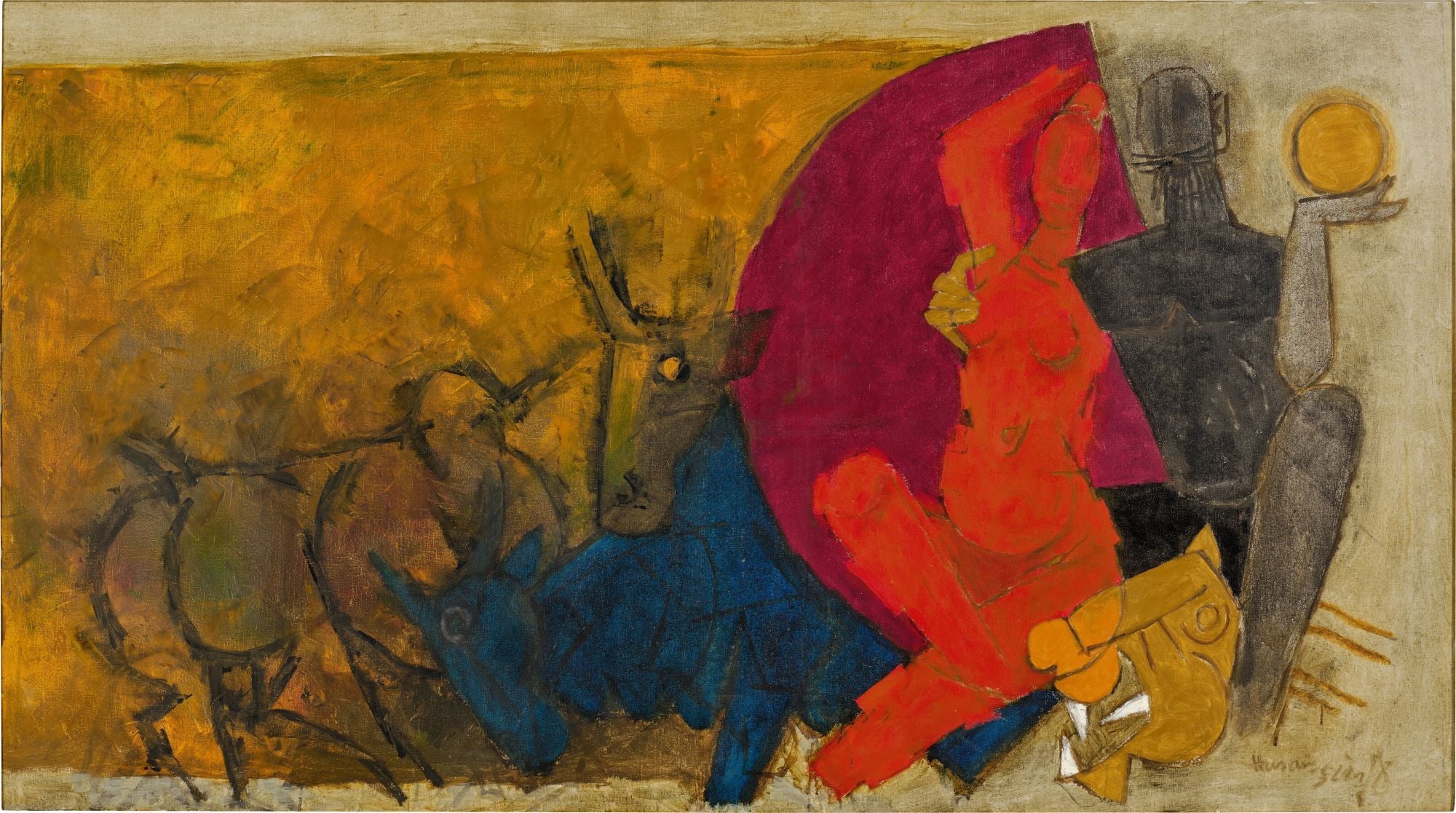
A Landmark Husain Returns to Market
The sale's standout lot is Maqbool Fida Husain's Mithuna Crimson, a work that captures the artist at his most assured. Husain, among the most consequential figures in twentieth-century Indian art, forged a visual language of his own, pulling from classical and mythological sources even as he remained alert to the shifting society around him. His figures, rendered with bold, gestural lines and a palette that favours intensity over subtlety, reflect an artist equally at home with ancient iconography and the pace of contemporary life.
Mithuna Crimson carries provenance to match its ambition. It once belonged to Chester and Davida Herwitz, whose collection helped define serious engagement with modern Indian art in the West, and it featured in Husain's first solo institutional exhibition abroad, staged at the Worcester Art Museum in 1974. That exhibition marked a turning point in how Indian modernism was received internationally, introducing American audiences to an artist who would go on to become one of the country's most celebrated cultural figures. More than fifty years on, its return to auction gives collectors a rare chance to acquire a painting with a documented place in the artist's international standing, one that has passed through a collection widely regarded as foundational to the field.
Khakhar's Estate Piece Anchors the Sale
Equally significant is Bhupen Khakhar's Old Men Playing Chess, a large-scale painting consigned directly from the artist's estate. It was shown in 1972 as part of Truth is Beauty and Beauty is God, Khakhar's exhibition at Bombay's Chemould Gallery, a show that helped establish him as one of the most distinctive voices to emerge from India in the postwar period.
Khakhar's work grew out of the artistic circle centred on the Faculty of Fine Arts at Maharaja Sayajirao University in Baroda, and his paintings are known for bringing everyday life and ordinary people to the fore, rendered with a mix of close observation, wit and psychological depth. He approached his subjects, often drawn from the small-town middle class, with an intimacy that set him apart from many of his contemporaries, blending narrative detail with a painterly sensibility that could be both tender and unsparing. His inclusion sets up one of the sale's guiding threads.
Baroda in Focus
The auction gives particular weight to the artists who trained or taught at Baroda, whose Faculty of Fine Arts became one of the most consequential centres for art in post-independence India. Established as a hub for experimentation rather than orthodoxy, the faculty drew together painters, sculptors and printmakers who pushed against the more established schools of Bombay and Calcutta, favouring instead a more personal and often narrative-driven approach to image-making.
Alongside Khakhar are works by Shanti Dave and K.G. Subramanyan, together with Subramanyan's students Vivan Sundaram and Dhruva Mistry. Subramanyan himself was a central figure in shaping Baroda's identity, both as a practising artist and as a teacher whose influence extended across several generations of Indian art. Sundaram and Mistry, in turn, carried that inheritance into markedly different territory, the former through his engagement with installation and mixed media, the latter through sculpture that drew on both Indian craft traditions and international modernist forms.
What emerges is not a single house style but a shared inheritance: an environment that pushed artists to engage with Indian tradition and contemporary thought in equal measure. Across painting, sculpture and mixed media, the Baroda contingent demonstrates how individual that engagement could become, even as it helped steer the broader course of modern Indian art.
The Wider Story of South Asian Modernism
Beyond Baroda, the sale draws together a broad cross-section of the region's art. Francis Newton Souza, Sayed Haider Raza and Vasudeo S. Gaitonde each represent a distinct strand of Indian modernism: Souza's raw, confrontational figuration, Raza's meditative geometric abstraction rooted in the bindu, and Gaitonde's luminous, near-wordless canvases, which drew as much on Zen philosophy as on the Indian landscape. Rabindranath Tagore's presence reaches back further still, to one of the movement's earliest instigators, whose late-life turn to painting helped open the door for the generations that followed.
The scope extends past India's borders as well. Sri Lanka's George Keyt and Pakistan's Zahoor ul Akhlaq join sculptor Meera Mukherjee and Zarina, whose spare, minimal works turned on questions of home, displacement and memory. Keyt's paintings, steeped in the visual traditions of Sri Lankan temple art and Indian classical sculpture, offer a counterpoint to the more urban, cosmopolitan concerns of many of his Indian contemporaries, while Zahoor ul Akhlaq's practice, which moved fluidly between miniature painting and modernist abstraction, helped shape the trajectory of contemporary art in Pakistan. Mukherjee's bronze and terracotta figures, meanwhile, drew on folk and tribal traditions largely overlooked by the mainstream art establishment of her time.
Together, the works trace a period of remarkable artistic ferment across South Asia, reflecting the sheer range of voices and approaches that shaped the region's modern and contemporary art. Seen as a whole, the sale offers not just a survey of individual careers but a broader account of how modernism took root, diverged and matured across a region defined as much by its plurality as by any single artistic lineage.
Sotheby's Modern & Contemporary South Asian Art sale takes place in London on 29 September 2026 at 2pm BST.
Read More