

A Century of Motoring: Highlights from The Willy Michiels Collection
Nearly a hundred years of production, 28 marques, and more than 100 cars and motorcycles offered without a single unifying thread — RM Sotheby's September online sale of The Willy Michiels Collection is built on range rather than specialisation. European classics sit alongside sporting icons, luxury tourers alongside modern performance machines, the whole assembled, it seems, on the pleasure of variety itself.
Having spent years on static display, many of the cars will need mechanical attention before they return to the road, and RM Sotheby's is encouraging prospective bidders to inspect lots in person during the preview days of 12th and 13th September, ahead of the auction, which runs from 8th to 15th September.
Among the more than 100 lots on offer, three stand out as particular waypoints in the collection's sweep through automotive history: a Porsche roadster from the marque's formative years, a Mercedes-Benz grand tourer descended from motorsport, and a rare pre-merger AMG built at the very start of that partnership's story.
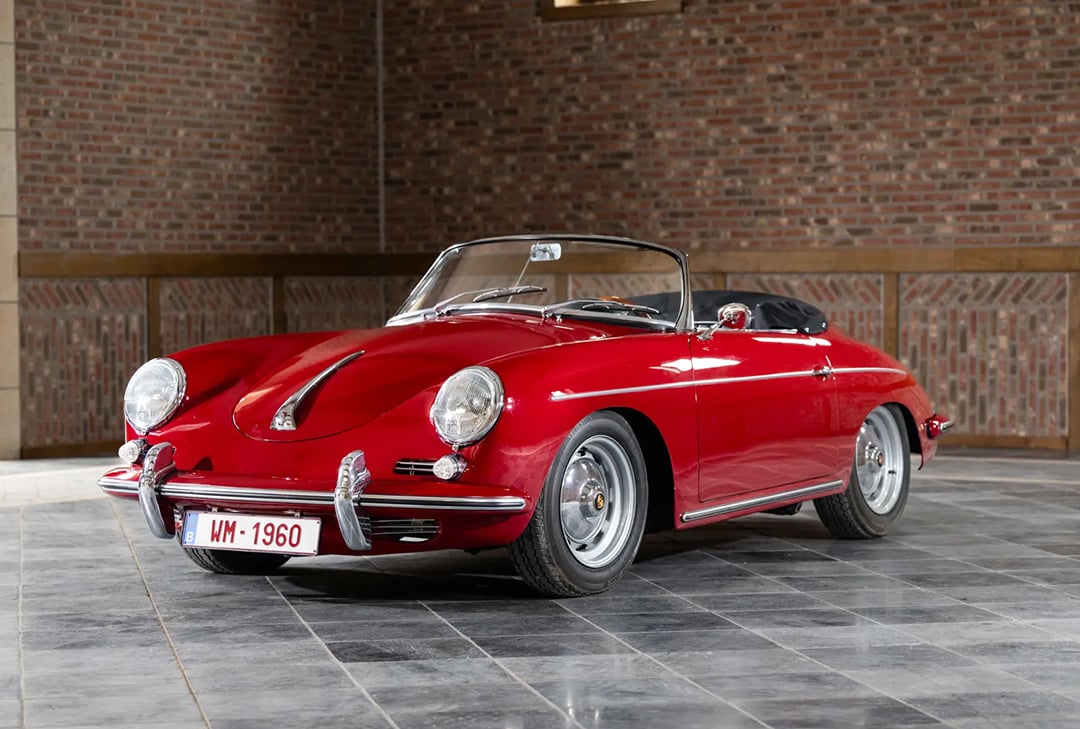
1960 Porsche 356 B 1600 Super Roadster by Drauz
Porsche's 356 B arrived as a successor to the 356 A Convertible D, and in Roadster form it leaned further into the sporting brief than its Cabriolet sibling — a removable windscreen frame, a pared-back Speedster-style fascia, a lighter folding roof, and the omission of rear seat cushions all sharpened the car's focus. In Super trim, the Type 616/2 flat-four engine produced 75 horsepower, a 15 horsepower gain over the standard 1600 that made the car noticeably livelier to drive.
Chassis number 87593, offered here, carries a Porsche Certificate of Authenticity confirming its build as a 1960 model year 356 B 1600 Super Roadster, originally finished in Ruby Red over a Light Grey leatherette interior and specified from new with reclining seats and Continental tyres. Its complete ownership history is not fully documented, though records suggest previous registration with the Fédération Internationale des Véhicules Anciens.
What matters most to prospective bidders is what remains: the car retains its factory-correct Ruby Red paintwork and its matching-numbers flat-four engine, paired with a replacement manual transmission. Of the roughly 2,650 examples of the T5-generation 356 B 1600 Super Roadster built between 1959 and 1961 — with as few as 350 allocated to the 1960 model year alone — this is a well-specified survivor from a genuinely limited run, offered without reserve.
1962 Mercedes-Benz 300 SL Roadster
If the Porsche represents Stuttgart's sporting instincts distilled into an accessible package, the 300 SL Roadster represents Mercedes-Benz reworking a competition car for the road. When the Gullwing's production run ended in 1957, the marque — with input from New York importer Max Hoffman — set about converting its race-derived platform into an open-top grand tourer. The transformation ran deeper than removing a roof: the welded steel chassis had to be substantially reengineered to accommodate conventional roll-down doors in place of the Gullwing's signature panels, a new rear axle was developed to improve stability, and revised lighting and a smaller fuel tank freed up boot space. With 215 horsepower on tap, the result was less a compromise than a fully realised evolution.
The car offered here, chassis 198.042.10.003070, is accompanied by a copy of its factory data card, stamped 4 June 1962, recording an original finish of White Grey paired with the desirable alloy-block engine — one of only 182 Roadsters built to 1962 specification out of 1,858 produced in total. Delivered new to Switzerland, the car's documented history resumes with a change of ownership in 1990, followed by a succession of restorations: a repaint and mechanical overhaul through the 1990s, further mechanical work at Garage Dupertuis in 2005, and — most significantly — a comprehensive restoration by Kienle Automobiltechnik in Germany between 2014 and 2018, documented across two accompanying binders.
That work left the car in its current Anthracite Grey Metallic livery over ivory leather, a striking departure from its original White Grey but one carried out to a high standard. The 300 SL has held pride of place in the Willy Michiels Collection since 2019, retaining matching-numbers bodywork, gearbox, rear axle, and kingpins, and is offered complete with its color-matched hardtop, owner's manual, and period catalogue.
1990 Mercedes-Benz 500 SL 6.0 AMG
The third lot marks a different kind of milestone — not in Mercedes-Benz's own history, but in the early years of its relationship with AMG. The two companies signed a cooperation agreement in 1990, three years before their formal merger, allowing a small number of AMG-enhanced models to reach customers through Mercedes-Benz showrooms during the interim. The R129-generation SL would later become the first factory-sanctioned AMG model in the modern sense, but before that, a limited pool of 500 SLs received the AMG treatment independently.
This car is one of them. Its 5.0-litre M119 V8 was enlarged to 6.0 litres, lifting output from 322 to 375 horsepower, and the transformation extended to a more aggressive body kit with a ducktail spoiler, three-piece OZ Racing wheels, gloss wood interior trim, and AMG-branded instrumentation. Ordered new through a dealership in Schweinfurt and completed in July 1990, the car was finished in Blue-Black Metallic over black leather before being registered in Japan that December — the intervening months likely accounting for its conversion by AMG. Service records include a 2016 workshop visit in Germany, and the car shows 77,468 kilometres on the odometer at the time of cataloguing, having been sparingly used during its time in the Willy Michiels Collection. As one of a genuinely small number of pre-merger 6.0 AMGs built, it represents a specific and lesser-known chapter in AMG's history — one that predates the badge's more familiar modern identity.
In Conclusion
Together, these three lots trace a shorter arc within the collection's broader century: from Porsche's early sporting ambitions, through Mercedes-Benz's reinvention of a motorsport icon for the road, to the origins of a tuning partnership that would go on to define an era of performance engineering. Each is offered without reserve as part of a sale that, in its scale and range, offers collectors an unusually direct route into the stories these cars still carry.
Read More