

South Asian Edit: Bringing South Asian Contemporary Art to The World
South Asia has never submitted to a single story. Its histories are plural, its artistic traditions layered across centuries of exchange, rupture, and reinvention — and any exhibition that attempts to compress that complexity into a coherent whole risks losing precisely what makes it compelling.
Sotheby's South Asian Edit, on view at the New Bond Street flagship from 13 July to 7 August 2026, takes a more considered approach. Rather than a survey, it offers six focused encounters — each dedicated to an artist whose practice opened new ground — allowing the work to speak on its own terms. The result is a selling exhibition of rare intellectual breadth, one that rewards close attention.
Pioneering Artists and their Pieces
1. Francis Newton Souza | Crucifixion
To understand the arc of modern Indian art, it is difficult to avoid Francis Newton Souza. A founding member of the Bombay Progressive Artists' Group, Souza arrived on the scene in the years following Indian independence with a visual language that owed as much to European Expressionism as it did to the traditional imagery from the Indian subcontinent, and a temperament that made him unwilling to soften either. Religious iconography, portraiture, and landscape were constant underlying themes and came out charged with intensity that challenged social conventions. Owing to his exploration of faith, morality, identity, and the human condition, he grew to be known as the enfant terrible of modern Indian art.
Born in Goa in 1924, Souza relocated to London in 1949, which was followed by years of difficulty before a sold-out exhibition at Gallery One in 1955 brought his work to international attention. The ‘Black Paintings’ of the 1950s and 1960s remain the defining body of his output: raw, uncompromising, impossible to place neatly within either the Western or South Asian canon.
The centrepiece of his presentation in the South Asian Edit is Crucifixion (1984), a painting of altarpiece scale in which Souza depicts himself offering Communion beneath the Cross. The Last Supper, the Crucifixion, and the Eucharist are collapsed into a single composition that’s dense with symbolism, freighted with the ambivalence toward faith that animated his practice across five decades.
2. Mohan Samant | Music & Dance
Where Souza's career was defined by a singular, confrontational vision, Mohan Samant's was defined by its opposite: a refusal to be pinned down. A fellow member of the Progressive Artists' Group, a large part of Samant’s process was continuous experimentation across media, techniques, and imagery. He moved through the cave paintings of Lascaux, Egyptian hieroglyphs, Indian miniatures, African sculpture, and the innovations of Picasso with a restlessness that defied categorisation.
After training at Mumbai's Sir J.J. School of Art, he participated in the Venice Biennale in 1956 before settling eventually in New York, where his work entered the collections of the Museum of Modern Art and the Smithsonian American Art Museum, among others. Art critic Ranjit Hoskote's description of him as "the missing link in the evolutionary narrative of contemporary art in India" captures something of the problem: Samant's importance is real, but it has never been easy to place.
His presentation in the Edit centres on Samant’s Music & Dance, a series that draws together two preoccupations he sustained throughout his life. Sarangi Nawaz (2002) conjures a solitary musician through spectral, layered paint, a figure that seems to vibrate with the sound of the instrument Samant played throughout his life. Dancing Angels (1988) reaches toward mythology and performance, exemplifying the imaginative range of his later work.
3. Bhupen Khakhar | The woodcuts and linocuts for Salman Rushdie’s Two Stories
Bhupen Khakhar transformed the trajectory of post-independence Indian art by rejecting many of the established conventions of modern painting in favour of an unapologetically figurative and deeply personal practice. After beginning his career as a chartered accountant, he emerged as one of India's pioneering pop artists, finding inspiration not in abstraction but in the lives of ordinary people. Barbers, tailors, shopkeepers and office workers became the protagonists of his vividly coloured compositions, which drew equally from Indian mythology, popular culture and Western art history to create a distinctive visual language.
The exhibition is centred on a rare presentation of Khakhar's printmaking, a medium he explored extensively from the late 1980s onwards. Working across etching, lithography, serigraphy and relief printing, he translated his narrative sensibility into prints that retained the humour, humanity and immediacy of his paintings. A particular highlight is the complete suite of woodcuts and linocuts produced for Salman Rushdie's Two Stories, featuring illustrations for The Free Radio and The Prophet's Hair.
4. Zarina | Tasbih
Zarina occupies a singular place in contemporary printmaking, creating deeply resonant works that fuse geometric precision with reflections on memory, identity and the idea of home. Born in Aligarh in 1937, she embraced abstraction as a visual language, using restrained lines and carefully constructed forms to evoke contemplation rather than narrative. Her practice was shaped by a life spent across Asia, Europe and the United States, while the aesthetics of Islamic architecture and ornament remained a constant source of inspiration.
Her minimalist compositions continue to hold an important place in the history of contemporary printmaking, exploring themes of belonging, migration and place through remarkable economy of form. Among the exhibition's highlights is Tasbih (2012), a marble sculpture inspired by Islamic prayer beads. A recurring symbol in Zarina's work, it reflects her enduring interest in spirituality and material simplicity. Celestial imagery also threads through the exhibition, with Tied to the Sky (2017) and Thirty Birds Flying on the Dark Sky (2017) drawing on stars and constellations to contemplate transcendence, belonging and noor —the Islamic concept of divine light.
Also featured in The South Asia Edit are pioneering Pakistani artists Zahoor ul Akhlaq and Sheherezade Alam, whose works are presented in conversation, pairing Akhlaq's paintings with Alam's ceramics.
5. Sheherezade Alam | Later Ceramics
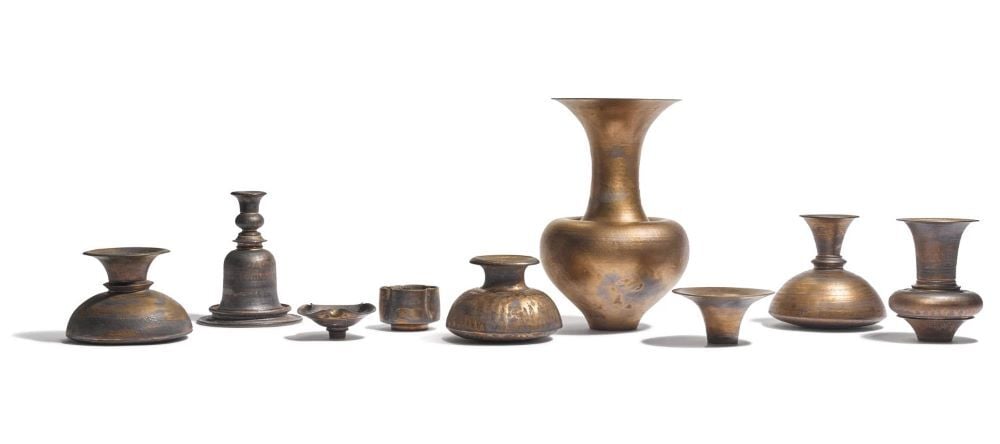
Sheherezade Alam founded Pakistan's first independent pottery studio established by a woman, and spent the decades that followed making clear that clay was not a craft material but a sculptural one. Born in 1948 in Lahore , and trained at the National College of Arts there, she drew on the ceramic traditions of the Indus Valley and the wider Islamic world and pushed them somewhere new — vessels that carry the memory of ancestral form while answering to an entirely personal vision. Her method: a deep exploration of form, surface, and proportion.
Thirty-two works from her later practice are gathered in this exhibition: dishes, vases, matka pots, and urali bowls finished with metallic lustres, speckled glazes, and fluted rims that sit at the boundary between function and sculpture. Taken together, they trace a sustained dialogue between innovation and inheritance — one of the most radical bodies of work in contemporary South Asian craft.
6. Zahoor ul Akhlaq | Radio Photo of Objects Unidentified
Zahoor ul Akhlaq remains an influential figure in South Asian art. Born in 1941 in Delhi, he is an alumnus of Lahore's National College of Arts, subsequently returning to the institution as a teacher. Akhlaq spent nearly three decades teaching at the college, with his artistic trajectory and style guiding his setting up arts education in Pakistan, with the formation of the National College of Arts’ Miniature Painting programme.
The artists who passed through his programme — Rashid Rana, Shahzia Sikander, Imran Qureshi among them — went on to define contemporary Pakistani art internationally. His influence as an educator rivals his considerable achievement as a painter.
That achievement rested on a singular synthesis: Mughal miniature painting, Islamic calligraphy, and vernacular architecture read through the optic of Cubism and Colour Field painting, producing a visual language that challenged the assumptions of both traditions without belonging entirely to either.
The grid recurs throughout his work as both compositional device and conceptual tool — a structure that holds abstraction and representation in productive tension. Radio Photo of Objects Unidentified (1983) and Untitled (1991) anchor his presentation, their layered fragments of image and architecture shifting between legibility and dissolution. They are paintings that reward sustained looking, and resist it at the same time.
Final Thoughts
For over 280 years, Sotheby's has placed significant works of art before discerning collectors. The South Asian Edit upholds that tradition by turning its attention to six artists whose practices changed the terms on which South Asian modernism is understood. The selling exhibition is on view from 13 July to 7 August 2026 at Sotheby's London flagship on New Bond Street.