

Dh1 Billion in Two Months: What Naïa Island's Plot Sales Reveal About Dubai's Super-Prime Market
Even regional uncertainty, it turns out, is not enough to keep the world's wealthiest buyers away from a good address.
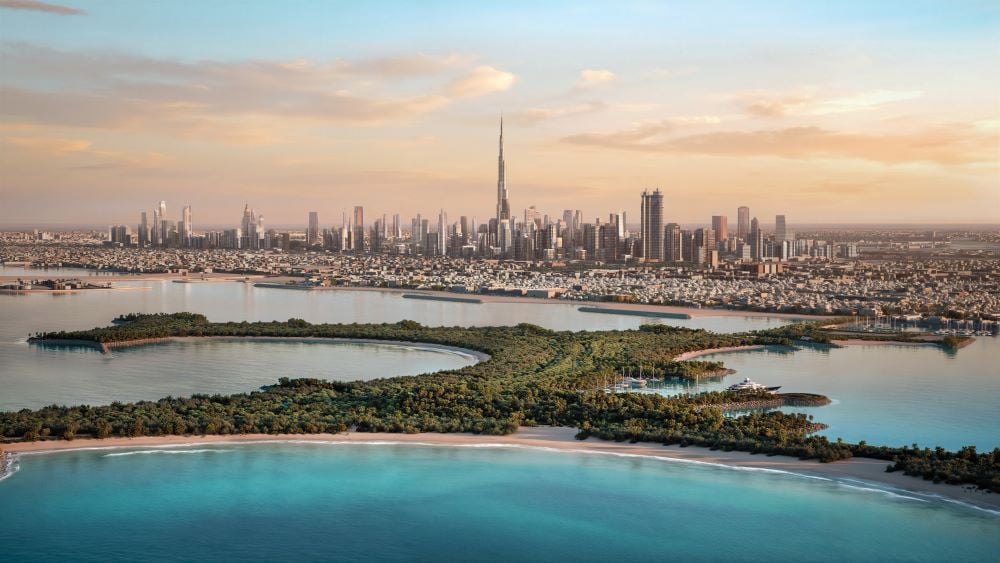
Between late April and mid-June this year, three beachfront plots on Naïa Island, the man-made development taking shape along the Jumeirah coast, changed hands for a combined Dh1 billion (roughly $272 million). The most recent, a coastal parcel sold to a Middle Eastern buyer for Dh167 million, followed a Dh560 million sale of a plot exceeding 80,000 square feet to a European buyer, and a Dh377 million transaction in late April. All three were sold through the expertise of Dubai Sotheby's International Realty, and went to end-users rather than investors looking to flip.
The timing is worth sitting with. The conflict that erupted in February, and continues amid intermittent pauses, has rattled the wider Gulf. By most measures, it ought to have introduced a degree of caution into big-ticket property decisions. To some extent, it has. As noted in our half-year reports, there has been some moderation in activity in response to global events. Dubai's overall residential transaction value for the first five months of the year, at close to Dh200 billion, is down roughly 10 per cent year-on-year. But the Naïa sales suggest that at the very top of the market, the usual rules of caution simply do not apply and that buyers, while certainly more measured in their decision making, are buying where they see the right level of value.
An Entirely Different Tier of Wealth
George Azar, Chairman and CEO of Sotheby's International Realty across the UAE, UK and Saudi Arabia, is keen to draw a distinction between this segment and the broader high-end market. Describing these transactions merely as land plot sales, he argues, risks suggesting they are within reach of ordinary investors seeking to grow their wealth. In reality, the scale and scarcity of the land in question puts these estates in a category reserved almost exclusively for ultra-high-net-worth individuals, of whom, in the Dh200 million-plus bracket, only a handful exist globally at any given time.
Naïa Island itself, developed by investment firm Shamal Holding, is built around a Cheval Blanc Maison Hotel and offers private villas, beachfront residences and estate plots designed for exactly this kind of buyer. According to Azar, the individuals acquiring land there are not chasing incremental appreciation. They are buying trophy assets, establishing a lasting foothold in a city they already regard as one of their global addresses, and doing so with a decisiveness that has little to do with market cycles. When the right asset appears, he suggests, the decision tends to move quickly, driven by scarcity rather than sentiment.
The Wealth Magnet Holds
None of this happens in isolation. The UAE has spent the past several years positioning itself as a serious draw for global wealth, through Golden Visa expansion, remote and retirement residency schemes, and sustained economic growth. Henley & Partners and New World Wealth estimate that the country attracted a record 9,800 relocating millionaires last year alone, with Dubai now home to an estimated 81,200 millionaires and 20 billionaires.
Recent transaction data reinforces the picture at the very top end. Dubai recorded 500 home sales above $10 million in 2025, a 15 per cent increase in volume on the previous year and a roughly 28 per cent rise in value, reaching $9.05 billion. Within that, sales above $25 million climbed by nearly 48 per cent annually, a segment that maps closely onto the kind of buyer now circling Naïa Island.
Expert analysis from those operating in the market points to a straightforward explanation for why prime land plots in particular have held up so well. Buyers at this level tend to be far less reliant on debt and are typically end-users, family offices, regional developers and private investors drawn by the ability to control design, privacy, plot size and location outright, rather than purchasing something already built. That degree of control, on a plot of genuinely finite waterfront land, is difficult to replicate anywhere else in the region.
What It Signals for the Market
Taken together, the Naïa transactions read less as an isolated curiosity and more as a data point in a broader trend: Dubai's super-prime segment appears to be operating on its own logic, largely decoupled from the caution shaping the rest of the market. Stability, infrastructure, tax treatment, connectivity and lifestyle remain the pillars underpinning that confidence, according to Mr Sajjad, and for a small pool of buyers with genuinely global options, those fundamentals have proven more persuasive than regional headlines.
For a market still absorbing the effects of a conflict on its doorstep, that is a striking vote of confidence, and one worth watching as more of Naïa Island's limited inventory comes to market.
Read More