Published: 29 January 2026
For years, Dubai’s live events calendar followed the weather. From October to April, the city hosted international tours, sporting fixtures, and large-scale performances. When summer arrived, schedules thinned. Artists moved on. Promoters waited.
When the Coca-Cola Arena opened in City Walk in 2019, it was designed to operate straight through those months. Fully enclosed and fully air-conditioned, it filled a gap the city had worked around for decades.
By staying open when other venues paused, the arena changed how live events were scheduled in Dubai.
Built for Climate, Not Compromise
The Coca-Cola Arena was built to solve a specific problem. Dubai had the audience, the demand, and the global relevance. What it lacked was an indoor venue capable of operating at full capacity through the summer, without forcing productions to scale back.
Designed by Populous, it became the first fully air-conditioned, multipurpose indoor venue of its size in the Middle East.
Inside, temperatures are maintained between 23 and 24°C, even during peak summer heat. The system adapts to crowd density and event type, reducing energy use during quieter moments and intensifying only when required. These efficiencies have cut energy consumption during events by more than 30 per cent.
The roof structure supports up to 190 metric tonnes of production equipment. That detail matters. It allows international tours to arrive without compromise. Lighting rigs, sound arrays, and stage builds remain intact.
The result is consistency. Summer no longer dictates what the city can host.
Capacity
Capacity at the Coca-Cola Arena reaches 17,000 for large concerts, but the building rarely feels fixed. A modular stage system and automated draping allow the space to contract or expand depending on what’s booked.
One week it’s set up for a full stadium show. A few nights later, the same space holds around 2,000 people for a comedian or an interactive talk. Business conferences appear on the calendar without displacing touring acts. Combat sports follow music shows without the venue needing days to reset.
City Walk
City Walk was developed by Meraas as a pedestrian neighbourhood. In the evenings, when temperatures drop, people walk between restaurants, cafés, and shops. Placing the Coca-Cola Arena here meant events could sit within an existing neighbourhood that already had footfall.
Unlike most large venues, the arena isn’t ringed by empty land or car parks. It opens directly onto streets lined with restaurants, cafés, and shops. People arrive early to eat nearby, and they don’t rush home when the show ends. A concert becomes an evening.
City Walk sits between Downtown, DIFC, and Jumeirah, close to where much of the arena’s audience already lives or works. It’s minutes from Sheikh Zayed Road and a short walk from the Burj Khalifa–Dubai Mall Metro Station. For weekday shows, that ease of access often makes the difference between attending and staying home.
The arena also changed how City Walk itself is used. With a 17,000-capacity venue, nearby apartments and hotels became more attractive to residents and visitors who want to be close to where things happen. Its presence gave the district a reason to stay busy after dark, week after week.
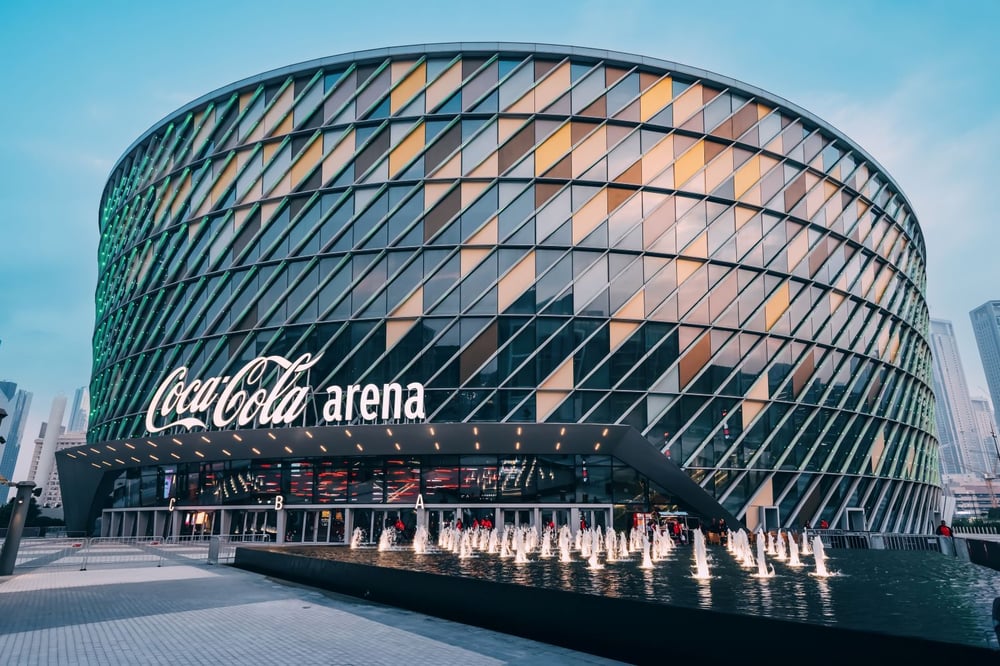
Visually, the arena feeds into the area. Thousands of LED strips wrap the façade, shifting colour to match what’s happening inside. On event nights, it’s visible from surrounding streets and nearby towers.
Operations
As of 2026, the Coca-Cola Arena has become a testing ground for how large-scale events can run more efficiently.
The venue operates fully cashless. Across 35 food and beverage outlets, digital payment is standard, keeping service quick and queues short even during peak intervals.
Behind the scenes, the arena’s Building Management System monitors crowd movement, temperature, and energy use. Using an event-specific energy strategy, airflow adjusts depending on whether the audience is seated for comedy or active during a concert. When sensors predict congestion near building exits, staff are redirected through a central dashboard before queues form.
For promoters, this shows up as smoother load-ins and fewer last-minute changes. For audiences, it’s simpler. Lines move faster. Temperatures stay steady. Events run to time.
The 500th Event Milestone
The Coca-Cola Arena reached its 500th event on Friday, January 23, 2026. The night was marked by a sold-out concert from LANY, performing in Dubai as part of their Soft World Tour.
After the show, the arena’s exterior lighting shifted to mark the moment. The façade’s 4,600 LED strips were programmed for a one-off display, acknowledging the scale of what had taken place.
More telling was what followed. Alongside the milestone, the arena announced a commitment to dedicate 500 hours in 2026 to mentoring emerging professionals in the regional events industry. The initiative focuses on hands-on experience across production, operations, and delivery, reflecting a venue now thinking beyond bookings and towards progressive impact.
By the time the 500th event arrived, the build-up spoke for itself. Concerts, combat sports, comedy shows, exhibitions, and corporate summits had all passed through the same space.
How It Compares
In scale, the arena sits alongside venues like London’s O2. In context, it operates differently.
The Coca-Cola Arena runs fully indoors in a climate that would otherwise shut down summer programming. Its modular seating allows for variation in event size. Its central location avoids the isolation common to large venues built on city outskirts.
Dubai didn’t replicate an arena model. It adjusted one for extreme heat and continuous operation.
What It Changed for the City
The impact of the Coca-Cola Arena shows in the events calendar.
Summer gaps in touring schedules have narrowed. Promoters no longer avoid the region between May and September. Global acts include Dubai in their routing. Corporate events plan across the full calendar. For residents, live entertainment is no longer tied to seasonality. For visitors, the city offers a consistent cultural programme regardless of temperature.
The arena added year-round capacity to a city where summer used to limit live events. It's infrastructure built for extreme heat.