Published: 24 February 2026
French sculptor Daniel Hourdé’s artworks rest somewhere between worlds of dream and nightmare, with human-scale expressionistic pieces that reveal his mastery of both technique and human anatomy. Entirely devoted to his artistic practice, Hourdé, together with Sotheby’s Paris, will now offer art lovers and collectors a rare opportunity to discover these treasures that the artist has patiently gathered over time.
The remarkable collection – assembled by Daniel Hourdé – is brought to auction on 25 February 2026, with a prior exhibition open to the public from 19 to 24 February 2026. The exhibition is also a chance for visitors to discover a unique setting: the artist’s studio, whose atmosphere will be recreated for a few days at Sotheby’s Paris.
A collector, dealer and leading figure in the field of early African and Oceanic art for more than forty years, Daniel Hourdé has been living and breathing art all his life and is now ready to pass it on to those who share his vision.
A Selection of Major Works
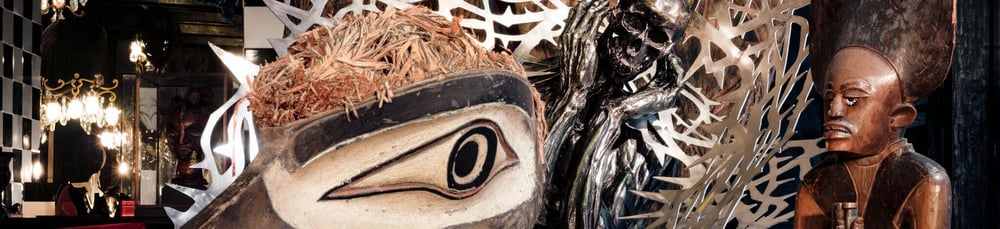
Sotheby’s auction will include some of Hourdé’s major works, from African, Oceanic and Pre-Columbian art to archaeological objects, Asian and religious art, as well as antique furniture. These are symbolic pieces that speak to the oneiric dimension of man's relationship with the world, remarkable for their ability to capture the kinetic energy of bodies moving and the enduring dialogue between humanity and the sacred.
One of the most significant entries is an exceptional Egyptian mummy mask dating from the 21st and 22nd Dynasties, followed by other notable pieces from New Ireland, several Kota reliquary figures from Gabon, a Māori prow figure, and a rare Kwakiutl mask from British Columbia. The highest record price achieved for the artist at auction since 2019 was 74,500 EUR for a piece titled Arbre, sold in 2023.
The Masterful Sculptor
At the age of 20, Hourdé studied painting and drawing at the École des Beaux-Arts of Grenoble and Paris, and since the 80s, he has mainly devoted himself to sculpture, bending classical form to his own will and language to create pieces that feel rooted in today’s mythology. Working in steel, bronze and gold, he uses each material to lend substance and give body and soul to his characters. He also expresses himself through drawing and installations, with an absolute freedom in his works about the human body, which is portrayed simultaneously as both tragic and playful.
His technique reveals an almost surgical understanding of human anatomy. The figures he creates are monumental and athletic, yet he disrupts that classical reference with playful details and flashes of pop culture, with the aim of pushing boundaries. His recurring motifs are: skeletons, the Cross and crown of thorns, the Fall and Redemption, and the medieval imagery of the dances of death from the Middle Ages. His characters appear caught mid-action, suspended in an existential moment that quietly asks the viewer to consider the vanity and mortality of the world.
Auction Highlights
An Egyptian Polychrome Wood Mummy Mask, 21st/22nd Dynasty, 1075-716 B.C.
125,000 - 175,000 EUR
Carved in a fine-grained hardwood, from the lid of an inner coffin, this impressive mask has oval face, inlaid eyes, with outlined lips deeply rounded at the corners, a straight nose and long eyebrows. The inlay of the eye is made of blue and white glass with recessed pupils painted in black, making this piece a singular entry and the most anticipated one to lead the sale.
Malagan Figure, New Ireland, Bismarck Archipelago, Papua New Guinea
80,000 - 120,000 EUR
While many Malagan figures represent powerful male presences, this one clearly shows a kneeling woman. This piece is a typical example of the quality of carving and pigments found in objects from the 1880-1890 period. Her pronounced ribs give the body a taut appearance, while a wide loincloth falls from her elongated arms hang down in deliberate symmetry. The legs are slender, almost abstract in their simplicity and her head crowned with a distinctive conical coiffure, worn by women in New Ireland as protection from rain.
This form does occasionally appear on male figures, including those once associated with Maurice de Vlaminck and another now held in the Field Museum in Chicago. Across the entire surface, geometric painted motifs animate the sculpture, reinforcing its ritual intensity and visual power.
Le Roi las
45,000 - 50,000 EUR
Le Roi las sculpture was executed in 2020, in bronze and painted steel. A bilbilcal story lies at the heart of this piece, but the interpretations belong just as much to personal mythologies. The theme here is both the ascent to Paradise and the descent into Hell. Le Roi las (The Weary King) is saturated with tension, and the crown represents its first disruption. The anatomy of this figure is almost forensic in clarity – the ribs and stretch of muscle across the torso are so visible, pointing to Hourdé’s impressive understanding of the human body. Yet, the irony in contrast is what makes this piece so profoundly dramatic: the body is athletic, powerful, but visibly strained. The ribs protrude. The head tilts. The posture suggests the burden of power and possibly the weight of expectation in a world where authority becomes futile.
Final Thought
Daniel Hourdé lives and works in Paris. His sculptures have been exhibited around the world, in notable venues such as the Pont des Arts at the French National Assembly in Paris and the Museo de la Cancillería in Mexico City. His art carries influences from classical mythology, contemporary social issues, and different cultures, drawing inspiration from the human form to create pieces that speak to movement, emotion and are rich in texture and detail.
Daniel Hourdé has earned a distinct place in contemporary sculpture. His masterpieces are recognised not only for their technical precision, but for the emotional charge they carry. There is weight in his figures, both physical and psychological, and it is precisely that balance between skill and symbolism that gives his art staying power.