Published: 06 January 2026
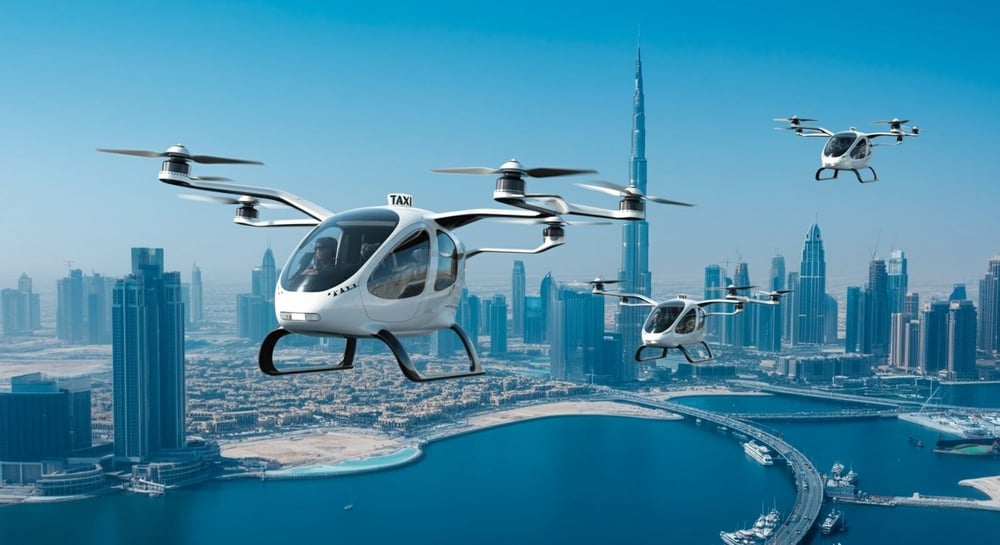
One of the world’s most anticipated transport projects, Dubai’s flying taxi initiative is currently in the final stages of testing before being rolled out in late 2026, with another development milestone recently passed – the first ever crewed flight of the aerial taxi. Hailed as a “new leap in urban mobility” by Sheikh Hamdan bin Mohammed Al Maktoum, the UAE’s Deputy Prime Minister, it is hoped the endeavour will help streamline traffic congestion while drastically cutting travel times. Let’s take a closer look at Dubai’s flying taxi service, set to revolutionise transport in the city forever.
The Latest Developments
As of November 2025, the city’s Roads and Transport Authority (RTA) and American firm JOBY Aviation have completed the first-ever crewed eVTOL air taxi flight. The inaugural manned trip was launched from Margham, in the Dubai desert, to the city’s Al Maktoum International Airport, where commercial operations will eventually be based once Dubai International Airport closes. Covering a distance of approximately 70 km by road, the journey would typically take around 47 minutes during off-peak traffic. However, the recent test flight completed the route in just 17 minutes.
The flight marks an important milestone on the road to commercial rollout for the company, with the service now expected to arrive in late 2026.
Dubai’s Vision for the Future
As Dubai continues to grow and to welcome a larger global population, there is a greater need for alternative transport solutions to avoid clogged roads. To address this, the city’s leadership has implemented several forward-thinking strategies that also align seamlessly with Dubai's Clean Energy Strategy 2050 – an ambitious initiative aiming to generate 75 per cent of the emirate’s energy from clean sources by 2050. In line with these goals, Dubai is set to become the first city in the world to offer this innovative flying taxi service, designed not only to ease the pressure on its roads but also to operate entirely on clean energy.
In 2024, the partnership between JOBY and the RTA was announced, another step towards sustainable transportation in the region. Specialising in electrical aerial ride-sharing, JOBY is at the forefront of design where pioneering electric aircraft is concerned, developing vehicles which offer a faster, cleaner and smarter way to carry people through their daily lives.
As of late 2025, the company has logged more than 30,000 miles flown on full-scale prototype aircraft and is now engaged in a multi-year testing program with the Federal Aviation Administration (U.S. federal government agency) in order to certify its vehicle for ongoing commercial operations.
A Closer Look at JOBY Vehicles
This futuristic aircraft, powered by six electric motors, takes off and lands vertically, making it versatile enough to serve nearly any community. Its forward-tilting propellers easily convert lift into thrust, enabling the aircraft to transition into forward flight like a conventional airplane while using energy far more efficiently than relying solely on vertical lift. This innovative design not only reduces drag for higher speeds but also ensures smoother transitions between hover and cruise, minimising abrupt movements. By generating lift more efficiently, the aircraft achieves longer range, enhanced battery performance, and improved stability and control.
With six separate electric rotors powered by individual motors, safety is at the forefront of the design. If one or two motors happen to fail, the aircraft can easily carry on flying – far safer than a traditional helicopter, which typically relies on two to four rotors. In case of electrical failure or battery malfunction, JOBY has installed a backup power system, allowing the aircraft to land safely in an emergency – providing enhanced peace of mind for would-be passengers.
The aircraft also boasts zero emissions and a noticeably quiet cabin, allowing for normal conversation during flight. Carrying a maximum of one pilot and four passengers, the vehicle has the capability of travelling at speeds of up to 200 mph. Demonstrating their dedication to innovation, JOBY has spent over a decade developing this state-of-the-art aircraft, resulting in a vehicle that feels less like a traditional plane and more like a sleek, futuristic SUV in the sky.
Routes, Prices and Launch Date
Known as vertiports, the first four locations have already been announced, strategically chosen to connect Dubai International Airport – one of the world’s busiest – to the city’s key business and tourist hubs. In Palm Jumeirah, the iconic Atlantis The Royal will host a vertiport, while Downtown Dubai will introduce its first facility at Dubai Mall, serving the city’s central business and financial district. The American University in Dubai car park – located along Sheikh Zayed Road in Media City – has been selected to provide easy access to Emirates Hills and Dubai Marina, and Dubai’s airport itself will also feature a vertiport, ensuring seamless connectivity for both visitors and residents.
Throughout 2026, the service will be offered free of charge to select individuals, allowing passengers to experience the system and provide feedback ahead of a full commercial launch at the end of the year. This initial phase will reportedly be open to personnel from government entities and companies close to the project.
Once the service is fully rolled out, fares are expected to be structured like traditional taxis, based on time and distance. Shorter routes, such as between Palm Jumeirah and Dubai Marina, are projected to cost between AED 300 and AED 600, while longer journeys, for example, between Palm Jumeirah and the airport, could be roughly double. Pricing may also vary depending on the time of day, with subscription plans and membership options anticipated for regular users. For those seeking a premium experience, VIP packages will provide private cabins and personalised flight schedules.
Evaluating the Feasibility of Dubai’s Flying Taxi
Although initially offered at a premium, Dubai’s flying taxis are set to deliver significant benefits to the city. Among the most notable is the reduction in travel times – a key advantage in a city facing growing traffic congestion. Bypassing heavy road traffic, particularly during peak hours, the service will become an invaluable option for those seeking to optimise their schedules and make the most of their time.
Furthermore, their fully electric design makes these vehicles a sustainable alternative to traditional taxis or helicopters, an important advantage for a modern city focused on environmental responsibility. The initiative also supports Dubai’s broader ambition to become a truly sustainable city, contributing directly to the objectives of the Dubai Clean Energy Strategy 2050.
For many, particularly tourists seeking a unique experience in the city, the cost is likely to be outweighed by the opportunity to enjoy cutting-edge aviation technology while bypassing traffic.
As part of Dubai’s push towards sustainability, the joint initiative between JOBY and the RTA is poised to overhaul traditional transportation in the city, reducing travel times, easing road congestion, and promoting the use of clean energy. With the service scheduled for rollout at the end of 2026, residents will soon experience the future of urban travel, right here in Dubai.