Published: 15 December 2025
Since 2023, Etihad Rail has been moving freight across the UAE, transporting industrial goods between ports and logistics centres. Silver locomotives and long lines of freight cars were visible from highways, but they weren't carrying passengers.
In 2026, passenger services are scheduled to launch in phases throughout the year. When they do, commutes will be counted in minutes rather than exits to take. Living in Abu Dhabi while working in Dubai will stop being a two-hour drive through traffic. It will be a thirty-minute train ride. Etihad Rail announced the first stations across Abu Dhabi, Dubai, Sharjah and Fujairah.
The Network
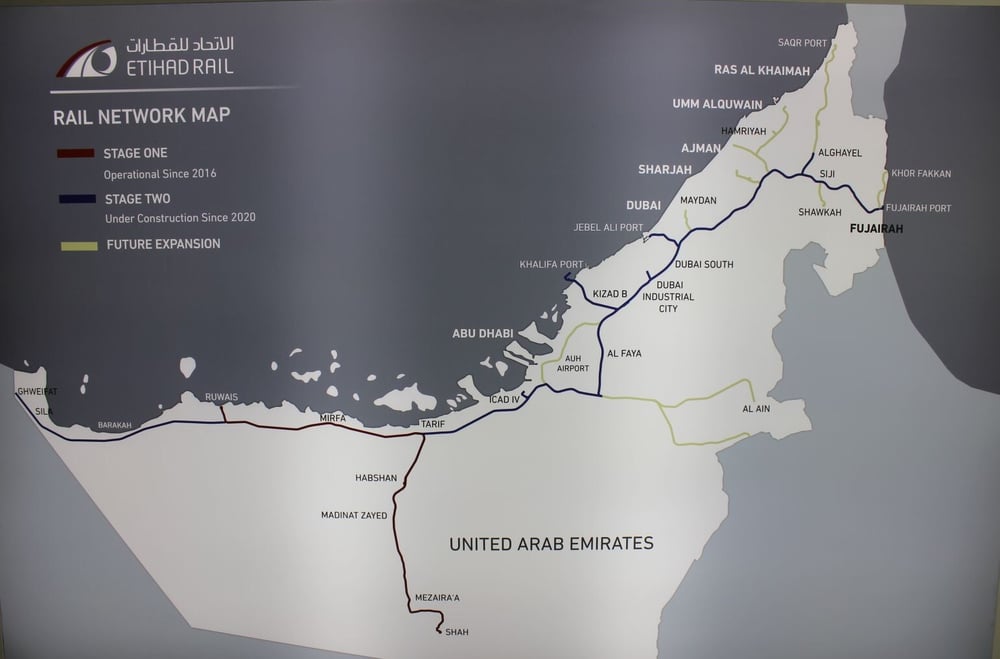
The passenger rail network spans 1,200 kilometres, connecting 11 cities across the UAE. It's the country's first fully integrated national passenger railway.
The standard service travels at 200 km/h, with the Dubai to Abu Dhabi journey taking 57 minutes. A separate high-speed link reaches 350 km/h, cutting the same journey to around thirty minutes. Dubai to Fujairah, currently a two-hour drive through mountain roads, drops to fifty minutes by rail.
Speed helps, but reliability means more. Road travel between emirates depends on timing, congestion, and construction. Rail removes most of those variables. Departures run to schedule. Arrival times stay consistent. That certainty affects decisions about where people are willing to live.
Building infrastructure at this scale required 24.5 million working hours and over 7,000 workers across three years of planning and construction.
During peak hours (6–9am and 5–8pm), trains are expected to run every 30 minutes, shifting to hourly services off-peak. Tickets will be available via the Etihad Rail app and website. Standard class fares for Dubai to Abu Dhabi are expected to be between AED 35 and 50, with First Class around AED 100–120. Family Class will sit between the two.
Where People Get On
Dubai's passenger rail access is built around three stations, each serving different needs.
For daily commuters, Jumeirah Golf Estates is the most practical entry point. The direct connection to the Metro Red Line means rail, metro, bus, and taxi all work within the same system. The NOL card still applies. There's no new process to learn, which matters when rail is meant to replace a drive, not complicate it.
Further south, Dubai South's station sits alongside Al Maktoum International Airport. As DWC expands, this stop is positioned to serve airport passengers and longer-distance travellers moving in and out of the city.
Al Jaddaf serves a different purpose. As part of the high-speed network, it brings passengers straight into Dubai Creek's business and heritage districts. For professionals based in Abu Dhabi but working near DIFC or Downtown, this makes the commute workable.
Beyond Dubai
Abu Dhabi's main station sits in Mohamed bin Zayed City, serving as the capital's primary rail access point. The location provides connections to Yas Island and Zayed International Airport, bringing suburbs like Mussafah and Shakhbout City within a one-hour radius of the entire UAE rail network. A separate station in Al Dhafra serves the western region, with connections planned to Al Ain.
Sharjah's station is positioned in University City, giving the student population direct rail access without driving into Dubai. Fujairah's station in the Al Hilal area (near Sakamkam) serves the east coast and the eastern region.
Each station is built with parking, taxi ranks, and bus connections, replicating the integrated transport model that works at Jumeirah Golf Estates.
What the Journey Feels Like
The trains are silver and streamlined, built to operate in extreme heat. Air-conditioning is designed for temperatures exceeding 50°C. Wi-Fi is available throughout. Charging ports are standard, and catering runs on most services.
The views are a secondary benefit, though not an insignificant one. The line cuts through the Al Hajar Mountains on the route to Fujairah and crosses sections of the Liwa desert that most residents never encounter by road. For those used to highway driving, the landscape offers something different.
What This Means for Property
Rail access is already influencing property markets near planned stations.
In areas such as Dubai South, Dubai Investment Park, and Jumeirah Golf Estates, developers are highlighting proximity to rail ahead of passenger launch. Buyers are factoring future connectivity into decisions before services begin.
The reason is simple. If Abu Dhabi becomes a thirty-minute journey rather than an hour or more, living in Dubai becomes realistic for people working in the capital and vice versa. That widens the buyer pool for homes near stations and supports demand in those locations.
Freight has already transformed logistics. Since operations began in 2023, connecting Jebel Ali Port to the wider GCC network has reduced highway truck traffic by an estimated 70–80 per cent. One freight train replaces hundreds of trucks. Delivery times have shortened, and routes have adjusted accordingly.
The rail programme has also created more than 9,000 jobs, including operations, maintenance, and station management.
The Environmental Impact
Once passenger services begin, rail will replace a portion of daily car journeys for long-distance commuters. That reduces fuel consumption, eases pressure on highways, and lowers emissions on inter-emirate routes.
Rail alone won't meet the UAE's Net Zero 2050 targets, but its contribution is measurable. Congestion will ease on corridors where rail is a viable alternative. Accident rates will drop as fewer people drive long distances between emirates.
What's Next
The network continues to expand beyond the initial passenger launch. Hafeet Rail will connect the UAE to Oman's port at Sohar, extending the system beyond national borders. Links to Saudi Arabia are also planned, with the longer-term aim of a pan-GCC rail network.
What launches in 2026 as domestic passenger service is infrastructure designed for regional connectivity. The network connecting emirates is built to eventually connect countries.