Published: 10 March 2026
The Ritz-Carlton is a name long associated with grand city hotels and resort destinations, but in recent years, the brand has confidently expanded into a new frontier: the high seas. First launched in 2022 amid the post-pandemic luxury travel boom, The Ritz-Carlton Yacht Collection isn't a cruise line in the conventional sense. It's a boutique hospitality concept built around small, suite-only superyachts that sail more like private charters than floating resorts. The first yacht, Evrima, established the blueprint: 149 opulent suites, all with private terraces and spacious living areas designed to feel like home. The fleet has since expanded with Ilma, which entered service in September 2024 with 224 suites, followed by Luminara in 2025. All three vessels are substantially smaller than standard cruise ships, which means they can slip into smaller ports and hidden harbours that larger liners can't reach.
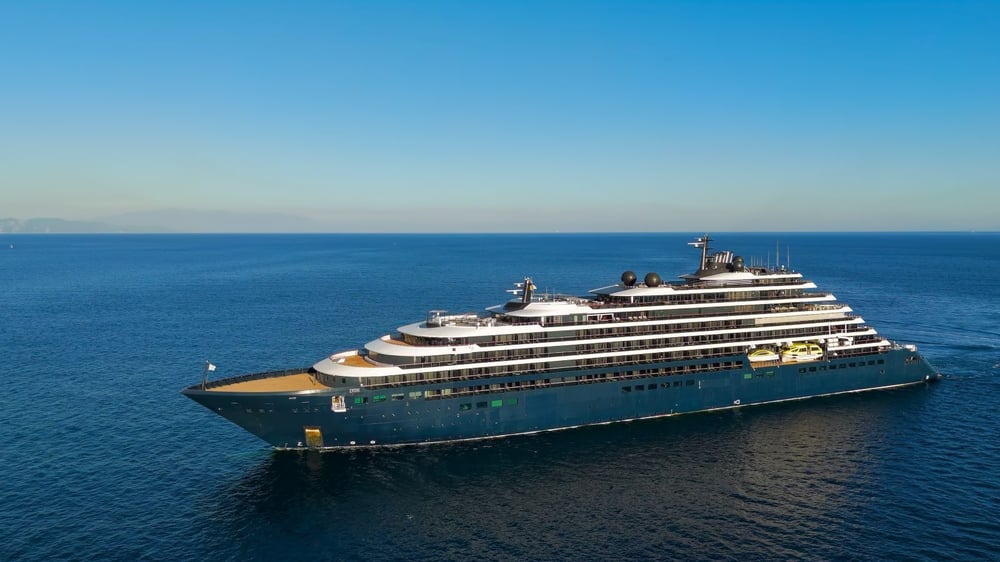
The Ritz-Carlton Yacht: What to Expect at Sea
Life on board a Ritz-Carlton yacht is deliberately modelled on the experience of a five-star hotel at sea, with the emphasis firmly on food, space and leisure. As in the brand's mainland properties, dining anchors the entire voyage. Each vessel hosts a curated collection of restaurants shaped by internationally recognised chefs, including Sven Elverfeld of the three-Michelin-starred Aqua in Wolfsburg, and Michelin-starred Italian chef Fabio Trabocchi. From morning cappuccinos and Bellinis on the prow to multi-course dinners below deck, every meal is an event worth lingering over.
Entertainment follows the same philosophy: thoughtfully curated rather than relentlessly scheduled. Resident musicians span Motown, jazz, and classical, while guest performers – including Broadway artists – rotate through depending on the voyage. Themed evenings bring variation to the stay: Havana nights with live salsa, En Blanc gatherings where everyone dresses in white, and occasionally, lively deck parties under the open night sky. The Ritz knows its audience, and on select voyages brings aboard historians, naturalists, and cultural guides to offer insights into the regions being explored.
One of the fleet's most distinctive features is the marina platform at the stern. When the yacht anchors, it opens directly to the water, allowing guests to swim, paddleboard along the coastline, or simply sit at water level with a drink in hand and nowhere in particular to be.
Accommodation onboard is suite-only, which keeps density low and the atmosphere intimate.
Where Does The Yacht Sail?
Routes shift with the seasons, but the collection has expanded well beyond the classic Caribbean and Mediterranean circuits. Summer voyages still concentrate on Southern Europe – Italy, Greece, Croatia, Spain, and the French Riviera – pairing ports like Rome and Barcelona with smaller harbours such as Portofino, Hvar, and Kotor. Many sailings include overnight stays, so guests can experience the destinations more meaningfully after the day-trippers have gone.
The Northern Europe and Baltic routes bring a different mood entirely. Baltic itineraries connect Stockholm, Helsinki, Copenhagen, and Tallinn, often weaving in lesser-known Scandinavian ports and island communities. Norwegian sailings thread through the western fjord coast – narrow inlets framed by waterfalls, fishing villages, and glacier-carved cliffs. With long summer daylight stretching close to midnight, these voyages unfold at a slow, otherworldly pace.
Alaska is one of the collection's most wild and cinematic offerings. Routes through the Inside Passage typically run between Vancouver and ports like Sitka and Icy Strait Point, where frontier towns meet vast swathes of wilderness. On the voyage, guests can expect whale sightings and excursions into national parks, set against the backdrop of dazzling glaciers and snow-capped peaks. The short season and rugged terrain give the route a sense of adventure that warmer itineraries simply can't match.
For those who prefer sunnier climes, the Ritz-Carlton Yacht also passes through the Pacific and South Pacific islands, calling at Hawaii, Bora Bora, and Papeete – each teeming with coral lagoons and stunning volcanic landscapes. Caribbean sailings remain a winter mainstay, visiting St. Barts, Antigua, Barbados, and the British Virgin Islands – often anchoring in small, quieter bays that larger ships can't reach.
Across all regions, the emphasis is on depth rather than density. Voyages feature fewer ports with longer stays, so you're not constantly packing and unpacking.
How to Book and Best Times to Sail
Voyages typically run between seven and fourteen nights, with bookings opening well in advance – particularly for limited-season itineraries in Northern Europe and Alaska, which tend to sell out quickly. Mediterranean routes offer the widest choice of dates, while Caribbean sailings dominate the winter calendar. Guests usually fly to the embarkation port independently, with private transfers and pre- or post-voyage hotel stays easily arranged through the brand. Prices vary by route and duration, but most seven- to ten-night voyages start above $10,000 per person, all inclusive. Bookings are handled exclusively through Ritz-Carlton.
For larger groups or special occasions, full-yacht charter is also available, allowing complete control over itinerary and onboard programming. For most guests though, the appeal lies in joining a small community of like-minded travellers and exploring multiple regions from a single, consistently comfortable base.
Final Thoughts
The Ritz-Carlton Yacht Collection reflects a broader shift in luxury travel, moving away from mass experiences and toward intimacy, consistency, and the comfort of familiarity. A 2024 report from Virtuoso found that nearly 80% of ultra-high-net-worth travellers now prefer smaller-capacity vessels and private experiences – a trend the Ritz is well-positioned to meet.
With fewer than 300 guests on board and a high crew-to-guest ratio, the experience feels markedly different from traditional cruise ships, where passenger numbers can run into the thousands. There are no fixed dining times, no formal dress requirements, and far fewer queues or crowds – just a pace that adjusts to the destination rather than the other way around. The idea is disarmingly simple: unpack once, settle in, and let the coastline change around you.