Published: 22 January 2026
The Air-King occupies a singular space in the Rolex pantheon. Long regarded as an affordable gateway into the brand, the model is sometimes overlooked as a modest, entry-level Rolex – a perception shaped more by price point than by provenance. Behind the humility of the Air-King though, lies remarkable lineage: introduced in 1945, the Air-King was born in the same year as the first Datejust, predating the Explorer, Submariner and GMT-Master by nearly a decade. Its origins trace back to the skies of World War II, where British RAF pilots reportedly wore Oyster Perpetuals during combat. Across eight decades, the Air-King has remained a pure distillation of Rolex design. From its earliest 34mm references to its modern rebirth as a 40mm sport watch with anti-magnetic engineering, the Air-King has charted an unusually dynamic path – one that reflects Rolex’s shifting priorities, technological advances, and evolving aesthetic language. Read on for a closer look at its history, notable references, collector interest, and current market value in the UAE.
Origins of the Air-King: A Tribute to War-Time Pilots
In the Second World War, many British RAF pilots favoured Rolex Oyster watches for their reliability under pressure. Rolex founder Hans Wilsdorf took note, and as the war drew to a close, he sought to commemorate the courage of these aviators – particularly those who served during the Battle of Britain – with a new series of pilot-inspired timepieces.
In 1945, Rolex introduced its “Air” line: a collection of straightforward, legible three-hand watches under names like Air-Lion, Air-Tiger, Air-Giant, and Air-King. Of the group, it was the Air-King that stood out most – its name personally chosen by Wilsdorf, evoking mastery of the skies. While the rest of the Air-series faded from production after the war, the Air-King endured and became the quintessential Rolex pilot’s watch.
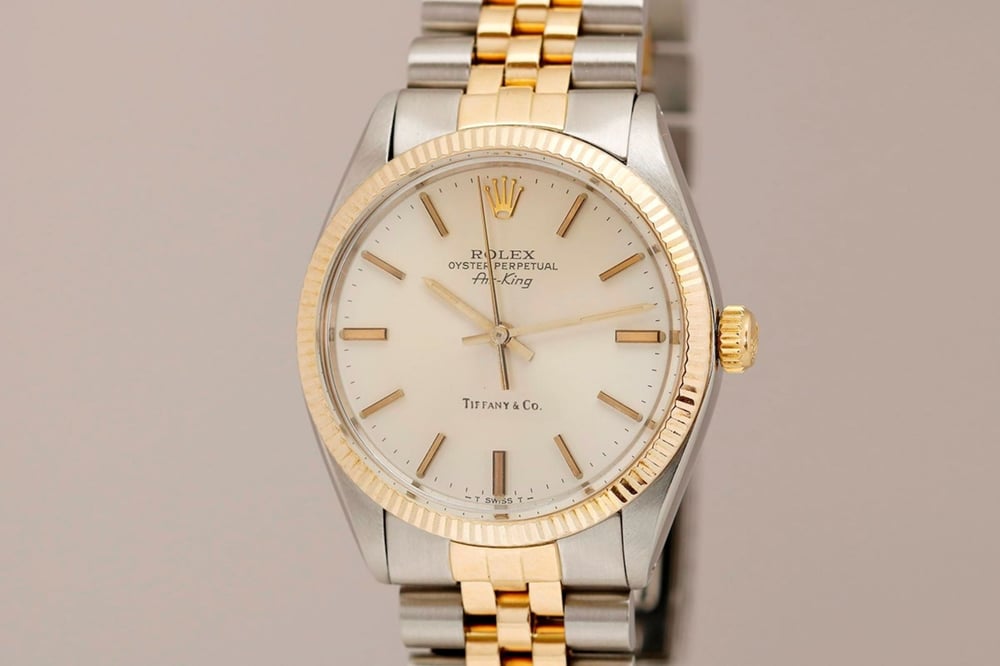
The earliest Air-King-branded models from the late 1940s were essentially variations of the Rolex Oyster Perpetual, often featuring manual-wind movements and rounded ‘bubbleback’ cases. References such as 4925 and 4499 were among the first to bear the Air-King name, though at the time, Rolex grouped them loosely within the broader Oyster family. It wasn’t until 1958 that the Air-King emerged as a standalone model, solidifying Wilsdorf’s wartime tribute into a permanent collection piece.
This quiet but purposeful evolution laid the foundation for one of Rolex’s longest-running production models. With its roots in the RAF and its sights set on post-war horizons, the Air-King combined the spirit of mid-century aviation with the emerging reputation of Rolex as a brand defined by precision and durability.
Technical Evolution and Price of the Rolex Air-King Today
One of the most significant design shifts in the Air-King’s history came in the late 1980s. With the launch of reference 14000, Rolex modernised the line with a sapphire crystal, a COSC-certified calibre 3000 movement, and a cleaner, more contemporary dial layout. Sized at 34mm and built in Oystersteel, it retained the model’s understated spirit while subtly bringing it into a new era. For many collectors, this reference marked the beginning of the Air-King as we know it today – sleek, reliable and wholly unpretentious.
In 2007, reference 114200 introduced further refinements, including the calibre 3130 and an engraved inner rehaut. Still modest in size and design, it was one of the last Air-Kings to fully embrace the minimalist ethos that had defined the line for decades.
In 2016, the Air-King took its boldest leap yet. The reference 116900 reintroduced the line after a two-year hiatus, this time as a 40mm sports watch with a striking new dial design and technical architecture borrowed from the Milgauss. The anti-magnetic shield inside the case, along with the calibre 3131, gave the Air-King the same magnetic resistance as its scientist-focused sibling – a far cry from the minimalism of earlier references.
The dial itself was equally polarising, featuring 3–6–9 Arabic numerals, a vivid green seconds hand, and the Rolex logo in green and yellow. While some collectors found the dial busy, others appreciated its nod to mid-century aviation instruments and its departure from the more conservative Rolex design codes.
Today, the Air-King is sized at 40mm (ref. 126900) and comes exclusively in Oystersteel. Beneath the bezel is calibre 3230 – Rolex’s latest-generation self-winding movement, with a 70-hour power reserve, Chronergy escapement, and resistance to magnetic fields – a nod to the Air-King’s technical crossover with the Milgauss. In the UAE, the Air-King retails at AED 32,650 and sells at a similar price on the secondary market.
Notable References
Rolex Air-King Ref. 5500 (1958–1989), ‘Domino’s Pizza’
The reference 5500 is the definitive vintage Air-King, and one of its most unexpected variants is the rare ‘Domino’s Pizza’ dial. Issued in the 1970s and ’80s as an incentive award for high-performing Domino’s franchise owners, these watches featured the company’s red-and-blue logo printed directly at 6 o’clock. Mechanically identical to the standard model, it retains the familiar 34mm Oystersteel case and non-chronometer automatic movement. Once an industry curiosity, the Domino’s Air-King now commands up to AED 80,000 on the secondary market – a testament to the power of provenance, and the strange corners of Rolex history that continue to surprise collectors.
Rolex Air-King Ref. 126900 (2022–Present), Crown Guards Debut
In 2022, Rolex unveiled the Air-King ref. 126900, a refined evolution of the 116900. While the dial kept its familiar aviation styling, including the 3–6–9 numerals and a green seconds hand, the case received a more technical redesign. Most notably, crown guards were added for the first time, aligning the Air-King more closely with Rolex’s Professional tool watch aesthetic. With its 40mm Oystersteel case, updated bracelet, and sharper symmetry, the 126900 positions the Air-King as a fully fledged modern sports model – still somewhat unconventional, but firmly resolved in its design language.
Final Thoughts
The Air-King has always been a watch slightly out of step with the rest of the Rolex catalogue, and that’s part of its appeal. Once considered the “forgotten Rolex”, it’s now gaining recognition for exactly what sets it apart: authenticity, accessibility, and increasingly – personality. Whether it’s a vintage ref. 5500 worn with pride or the current 126900 with rugged crown guards, the Air-King remains a tribute to purposeful watchmaking.