Published: 18 December 2025
If the Day-Date is the Rolex with presidential pedigree and the Daytona is the one with a Hollywood aura, the GMT-Master II is where Rolex charters pop culture territory. Born during the golden age of commercial flight and space exploration, the original GMT-Master was built for international air travel, introducing a fourth hand and rotating bezel to track multiple time zones at once. Over the past 70 years, it has graced the wrists of astronauts, pilots, and film stars, and it remains one of the most collectible models in the Rolex canon, anchored by a design language that’s as resonant today as it was in the mid-century. Read on as we uncover one of Rolex’s most fashion-forward pieces: the GMT-Master II.
The Story of the GMT-Master – A Watch for the Skies
When the jet age took flight in the 1950s, Pan Am approached Rolex to create a wristwatch that could track two time zones simultaneously – both local time and Greenwich Mean Time, the global standard for aviation. The result was the GMT-Master, released in 1955 with the inaugural reference 6542. Based loosely on the Turn-O-Graph, it featured a 24-hour hand that made one full rotation per day, and a bidirectional bezel marked with a 24-hour scale. The most distinctive feature though, was the bezel colour, split in red and blue to differentiate day from night.
Originally designed for commercial flight crews, the GMT-Master quickly ascended to historic airspace. In July 1959, it accompanied Pan Am’s first non-stop flight from New York to Moscow – a Cold War-era milestone that carried American journalists to cover Vice President Richard Nixon’s visit to the USSR. The Captain of the Boeing 707 – C.N. Warren – wore a GMT-Master and later remarked: ‘The flight itself was navigated by Rolex’.
Its reputation for high-altitude reliability continued through the 1960s, when the U.S. Air Force and NASA launched the X-15 hypersonic research programme, laying the groundwork for manned spaceflight. When test pilot William J. Knight reached Mach 6.7 in 1967 (a record that still stands), he did so wearing a GMT-Master.
The most storied appearance came in 1970, aboard the ill-fated Apollo 13 mission. When an onboard explosion forced the crew to abort their planned moon landing, astronaut Jack Swigert – wearing his personal GMT-Master – was tasked with manually timing the spacecraft’s engine burns to ensure proper re-entry. Over four critical manoeuvres, he used the watch to guide the capsule back on course. On 17 April, Apollo 13 splashed down safely in the Pacific, showcasing the GMT-Master as a deeply reliable tool watch at altitude.
Also Read: The Most Expensive Rolexes Ever Sold
The GMT-Master II – Specifications and Market Value
In 1982, Rolex introduced a major technical update to the GMT-Master line. The new model, now called the GMT-Master II, featured a movement that allowed the hour hand to be set independently of the 24-hour hand, letting travellers adjust local time without interrupting the watch’s function. It was a subtle but practical evolution, and one that would go on to define the modern GMT. Today’s references are sized at 40mm and powered by Rolex’s calibre 3285 – a self-winding automatic movement with a 70-hour power reserve and Chronergy escapement.
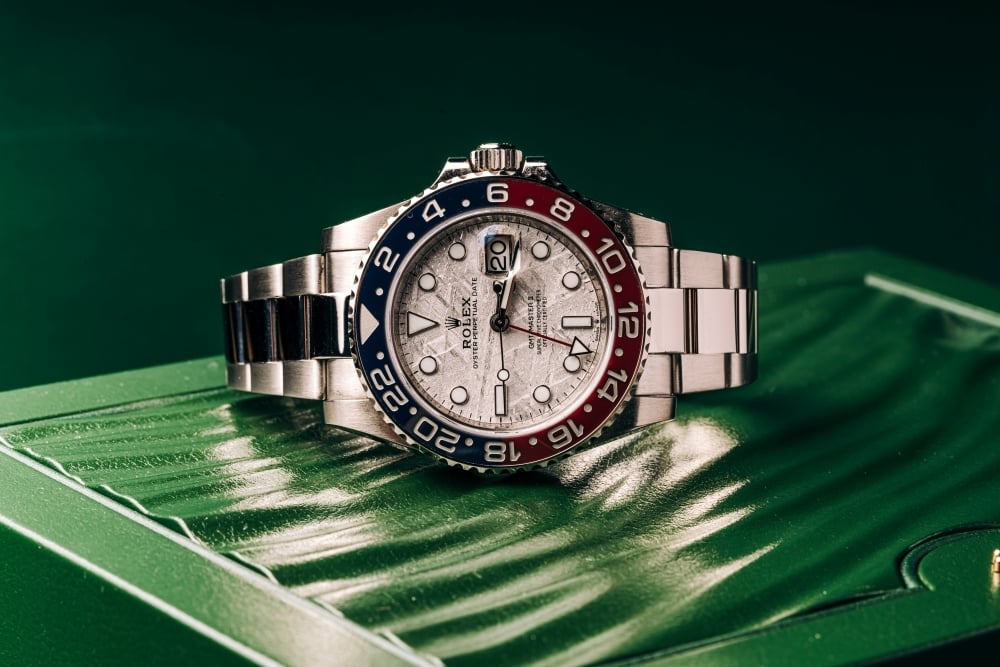
The GMT Master-II is offered in both Oystersteel and precious metals, with colour palettes that remain faithful to the model’s roots: the red and blue “Pepsi,” the black and blue “Batman,” and the brown and black “Root Beer”.
In the UAE, retail prices for the stainless steel GMT-Master II start at around AED 44,050, though most authorised dealers operate long waitlists, particularly for the Pepsi and Batman references. On the secondary market, premiums of 30–50% are not uncommon, with prices ranging from AED 60,000 to 80,000 depending on year and condition. In 2025, Rolex introduced a series of spectacular new precious metal variants, including the Tiger Iron “Root Beer” in full Everose gold (AED 201,600), and the green-and-black “Sprite-Hulk” in white gold (AED 190,700) – each pushing the GMT aesthetic into bolder, more expressive territory.
Also Read: Rolex Watches for Men
Notable Examples of the Rolex GMT-Master & GMT-Master II
Rolex GMT-Master Reference 6542 (1955) – The First Pan Am GMT
The GMT-Master ref. 6542 is where the story begins. Introduced in 1955 and produced for just five years, it laid the foundation for the GMT line with its fourth hand, two-tone bezel, and clean profile with no crown guards. Its most distinctive feature was the luminous Bakelite bezel insert, rendered in what would become the now-iconic red and blue “Pepsi” configuration. Visually arresting but notoriously brittle, the Bakelite was soon replaced with aluminium, making surviving examples with original inserts exceedingly rare.
The 6542 also secured a place in cinema history. In Goldfinger (1964), Honor Blackman’s character, Pussy Galore, wears a 6542 – a subtle but memorable cameo that earned the reference its enduring nickname. With its Cold War provenance, film legacy and short production run, the 6542 remains one of the most collectible GMTs.
The ‘Fat Lady’ (Ref. 16760, 1982)
The GMT-Master II made its debut in 1982 with the reference 16760 – a transitional model that introduced a crucial update: an independently adjustable hour hand, made possible by the new calibre 3085. The case was upsized to accommodate the bigger movement, earning the watch its enduring nickname, the “Fat Lady”. In 2025, a rare example gifted by David Bowie to his stage manager appeared at a Sotheby’s auction, adding pop culture provenance to an already collectible piece.
The ‘Pepsi’ Revival (Ref. 126710BLRO, 2018 – Present)
After years of producing the GMT-Master II exclusively in white gold, Rolex made waves in the market in 2018 with the release of the red-and-blue “Pepsi” 126710BLRO in stainless steel. Paired with a Jubilee bracelet, the release struck a chord with vintage purists while introducing a new, more accessible generation to the GMT’s legacy. At launch, the retail price sat around AED 35,000, but demand rapidly outpaced supply. Years-long waitlists became standard, and early examples traded at two or three times retail on the secondary market. As of 2025, demand has slightly cooled in favour of newer variants, including the green-and-black “Sprite”.
Also Read: 4 Rolex Watches for Ladies
Final Thoughts
Born from the optimism of the Jet Age, the GMT-Master II has stayed its course for over 70 years – visually consistent and culturally fluent. From luminous Bakelite bezels to bold two-tone dials, it’s one of the few Rolex models to embrace experimentation, which is why it resonates so well with contemporary collectors. Through every variation, it remains what it was always destined to be: a reliable companion for those on the move, and a benchmark in the travel watch category.