Published: 28 January 2026
If any Rolex evokes the spirit of life at sea, it’s the Yacht-Master. Introduced in 1992, this nautically inspired model marked the brand’s boldest foray into maritime timekeeping – designed not for the depths, but for the deck. While it shares its foundational DNA with the iconic Submariner, the Yacht-Master was never built for saturation diving. With a water resistance of 100m (versus the Submariner’s 300m), it trades technical extremity for visual presence and all-day wearability.
Its defining features – a bidirectional timing bezel, oversized hour markers, and heavy use of precious metals – positioned it early on as a kind of ‘luxury Submariner’, tailored to the sailing world. Over the decades, it has become a pillar of the Rolex Professional lineup, introducing new case materials, dial finishes, and bracelet designs. Today, the Yacht-Master straddles two worlds: a tool watch by category, but a treasure by execution, equally at home on the regatta course as on the Riviera terrace.
Broadening Horizons – The Evolution of the Rolex Yacht-Master
Rolex began experimenting with the idea of a sailing chronograph as early as the 1960s, with prototypes like the Cosmograph Yacht-Master circulating among collectors. But with attention focused on the Submariner and Daytona, the concept didn’t fully materialise until the 1990s. Unveiled in full 18k yellow gold, the Oyster Perpetual Yacht-Master Reference 16628 marked the first all-new model in Rolex’s Professional line since the Daytona, arriving at a time when luxury sports watches were firmly in vogue. Echoes of the Submariner were certainly there (the Mercedes hands, Triplock crown and Cyclops date window), but the intent was different, rooted in leisure rather than exploration.
In 1994, Rolex expanded the Yacht-Master line with 35mm and 29mm versions, marking the first time a Professional model was available in mid-size and women’s formats.
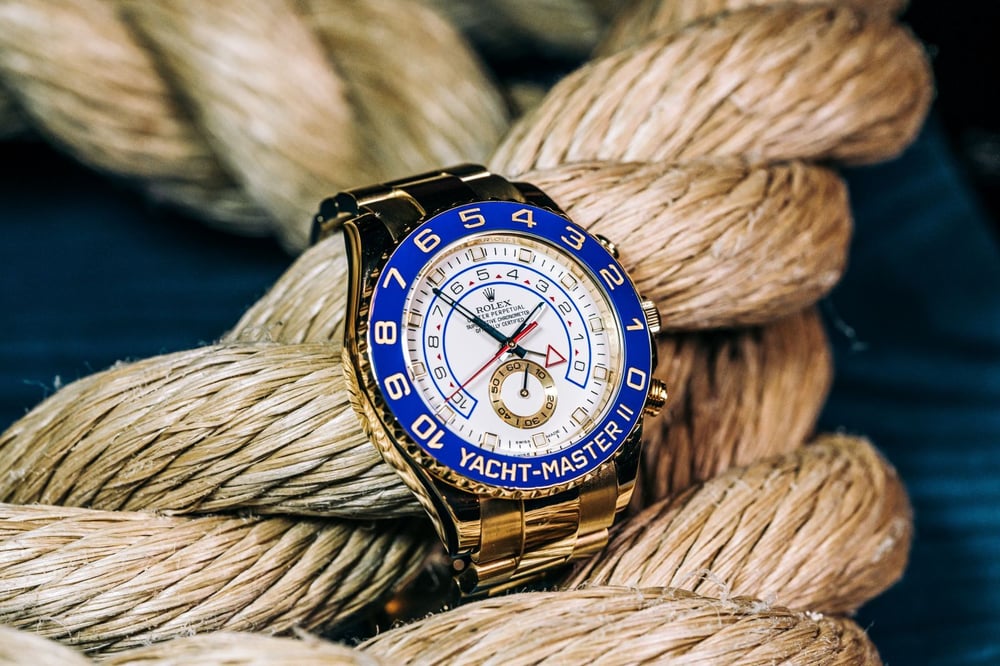
The most radical evolution came in 2007, with the spectacular Yacht-Master II. More than a continuation, the Yacht-Master II was a complete departure from the original model – a 44mm chronograph with a programmable countdown timer and mechanical memory. Initially released in precious metals (ref. 116688 in yellow gold and ref. 116689 in white gold), it introduced the new calibre 4160, Rolex’s first movement with programmable flyback regatta functionality. Its Cerachrom blue bezel, oversized case, and arcing countdown display bore little resemblance to the original Yacht-Master line and were designed specifically for precision timing on the race circuit.
Rolex discontinued the Yacht-Master II in 2024 after a successful 17-year run, and it remains a niche but coveted collector’s item, utterly distinct in its bright blue livery.
The Rolex Yacht-Master Today – Prices and Models
In recent years, the Yacht-Master has emerged as something of a testing ground for Rolex innovation, both stylistically and materially. In 2015, the Yacht-Master 40 ref. 116655 introduced two brand firsts: the use of Everose gold, and the debut of the Oysterflex bracelet – a high-performance elastomer strap reinforced with a flexible titanium blade. Paired with a matte black Cerachrom bezel and matching dial, the watch carried a sporty, contemporary aesthetic that quickly found favour with buyers.
The line expanded again in 2023 with the long-awaited arrival of the titanium Yacht-Master. The RLX Titanium 226627 – the lightest Rolex sports model to date – became an instant favourite after appearing on the wrist of Olympic sailor Sir Ben Ainslie.
Today, the Yacht-Master is offered in 37mm, 40mm, and 42mm sizes, with local retail prices starting from AED 46,650 for the Oystersteel and platinum Rolesium models. At the upper end of the range is the Yacht-Master 42 in Everose gold, priced at AED 202,400 – a head-turning showpiece with a glittering pavé diamond dial, paired with a sleek black Oysterflex band.
Examples With Collector Appeal
Rolex Yacht-Master Reference 16628 (1992) – The First Yacht-Master
Launched in 1992, the ref. 16628 was the original Yacht-Master – a bold, all-gold debut that set the tone for Rolex’s most gilded sports line. With a 40mm yellow gold case, bidirectional bezel, and the reliable calibre 3135 movement, it echoed the Submariner in layout but introduced more refined detailing: polished lugs, raised bezel numerals, and softer ergonomics. Today, this foundational reference has strong collector appeal and trades between AED 80,000–100,000 on the secondary market.
Rolex Yacht-Master Reference 16622 “Rolesium” (1999) – Steel Meets Platinum
In 1999, Rolex introduced a new material concept to its catalogue – one that would come to define the Yacht-Master’s identity. Dubbed ‘Rolesium’, the innovation paired a stainless steel case and bracelet with a platinum bezel and dial, creating a cool, silvery aesthetic that balanced presence with accessibility. The reference 16622, unveiled at Basel that year, marked the debut of this combination and went on to become the best-selling Yacht-Master reference. Its enduring popularity is reflected on the secondary market, where pre-owned examples typically sell between AED 28,000 and 35,000 – an elegant entry point into the early-era Yacht-Master legacy.
Rolex Yacht-Master 42 “RLX Titanium” (2023) – Sailing into the Future
The Yacht-Master 42 in RLX Titanium (ref. 226627) is the piece that marked Rolex’s first full-production titanium watch. Crafted from a proprietary alloy that’s 40% lighter than steel, it was designed with the rigours of sailing in mind: strong, corrosion-resistant, and ultra-light on the wrist. Originally field-tested by Olympic sailor Sir Ben Ainslie, the watch pairs a brushed titanium case and bracelet with a matte black Cerachrom bezel and black dial. Inside is the calibre 3235, offering a 70-hour power reserve and precision-grade Chronergy escapement. The result is a stripped-back, performance-led Yacht-Master that brings the line closer than ever to its tool-watch roots. Retailing at AED 60,500, the RLX Titanium regularly commands above AED 100,000 on the secondary market.
Final Thoughts
From its 18k gold debut to its titanium evolution, the Yacht-Master has carved a path of its own in the Rolex Professional lineup – more refined than a dive watch, and more advanced than a dress piece. Whether in Rolesium, Everose, or RLX Titanium, it remains true to its original spirit: built for the deck, engineered for performance, and timeless in design.