

Iconic Zaha Hadid Projects in the UAE
Born in Baghdad, Zaha Hadid trained in London at the Architectural Association, and it was in London that she later established her practice. For much of her early career, her reputation rested less on buildings than on paintings, drawings and competition entries. Recognition came regardless, and in 2004 she became the first woman to win the Pritzker Architecture Prize.
Her work first reached the Emirates through infrastructure. Abu Dhabi commissioned a third crossing to the island, and the Sheikh Zayed Bridge, completed in 2010, became her practice’s first finished project in the Middle East. Dubai followed with the Opus, which she unveiled in 2007. In Sharjah, the BEEAH headquarters fell to her through a competition in 2013.
Hadid died in March 2016, before either the Opus or the BEEAH headquarters was complete. Her London practice, now led by Patrik Schumacher, has since taken up the thread, with commissions that range from private residences on Palm Jumeirah to an entire district in Sharjah. Read in sequence, the projects narrow from the scale of a city to that of a single room, and each repays being judged by what it has to do where it stands.
The Opus, Dubai
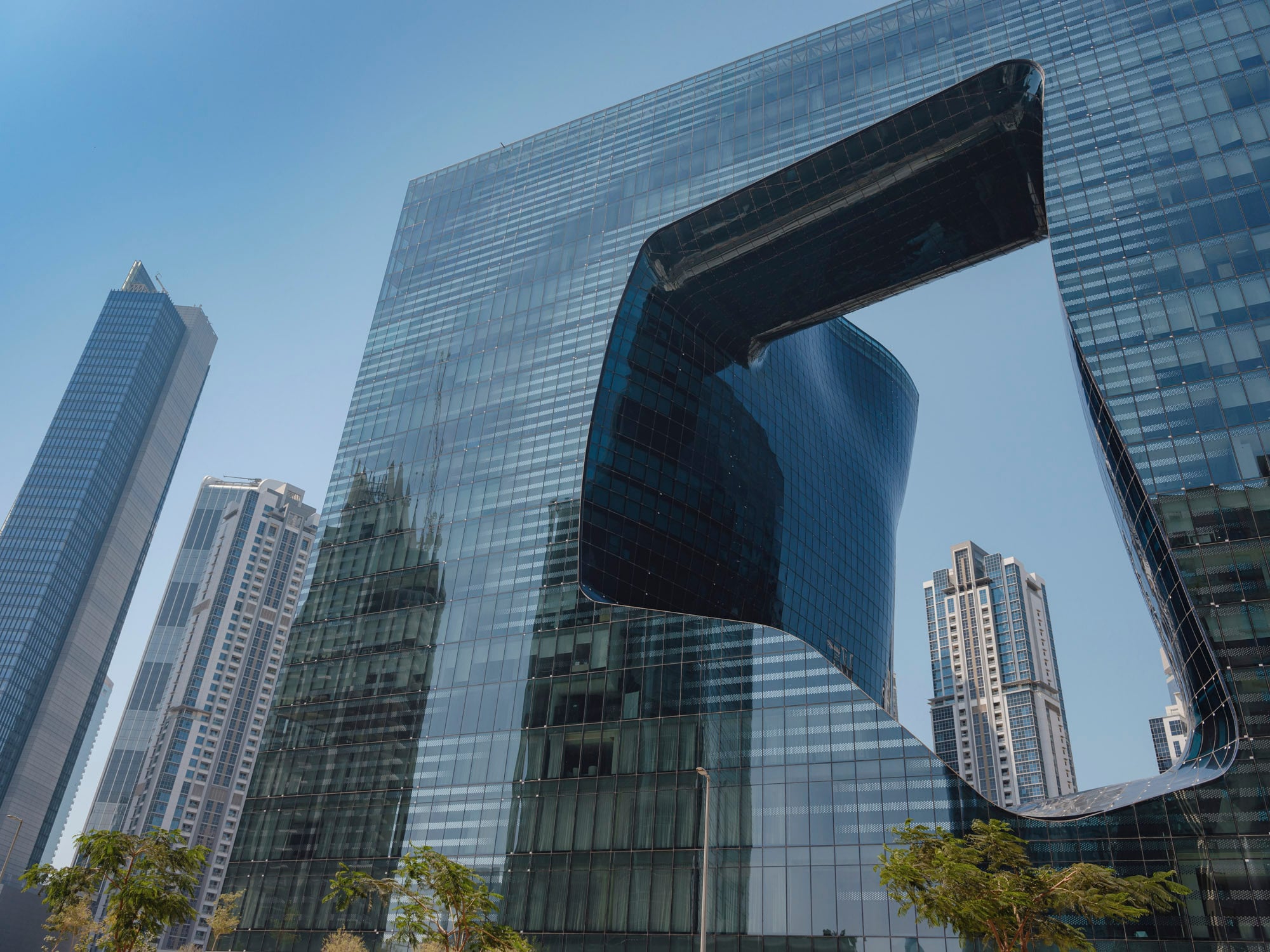
The most striking part of the Opus is, oddly enough, the part that is missing. In Business Bay, two glass towers meet to form an almost perfect cube. Through its middle runs an eight-storey void whose edges curve as though the glass had melted in the heat. That absence was drawn every bit as carefully as the floors around it.
The plain outline conceals a good deal of precision. At ground level the two halves are joined by a four-storey atrium, and 71 metres up they meet again in an asymmetric bridge three storeys deep and 38 metres wide. Lining the void are 4,300 glazing units, some flat and others curved in one or two directions, which between them cover around 6,000 square metres.
By her practice’s account, the Opus is the only hotel for which Hadid designed both the architecture and the interiors, the latter first shown at the London Design Festival in 2014. ME Dubai opened its doors in March 2020 with 74 rooms and 19 suites, and its lobby sits directly beneath the void, which serves as a glass ceiling. Furniture from Zaha Hadid Design runs throughout, from the Petalinas sofas and Ottomans seating pods downstairs to the Opus beds in every guest room. The curves, in other words, can be felt at the scale of a chair as readily as at that of a façade.
In the residences, the idea is carried into private life. Omniyat, the developer, describes its 96 furnished residences as the only homes in the world designed and furnished by Hadid. For an owner, then, the furniture is very much part of the address.
Hadid’s furniture has, moreover, found a following in the saleroom. Sotheby’s has offered her designs in its London and New York design sales for more than a decade. At Sotheby’s London in November 2015, the VorteXX light she designed with Schumacher sold for £106,250, the highest price achieved for lighting in that sale. Her Aqua table, made in 2005 by the London manufacturer Established & Sons, has come up in both cities. Residents of the Opus will recognise those curves at once, though not every piece in a furnished apartment would carry the same weight under the hammer.
Sheikh Zayed Bridge, Abu Dhabi
Bridges had linked Abu Dhabi Island to the mainland since 1967. This third crossing, opened to traffic in November 2010, was conceived as something more than a road. It runs for 842 metres. Its steel arches spring unevenly from concrete piers, tracing what Zaha Hadid Architects describes as a sinusoidal wave, and the main arch rises 60 metres above the water. With the two road decks cantilevered on either side of the central spine, the bridge’s profile shifts as you travel along it.
A bridge, of course, makes different demands of architecture from a hotel or a home. People meet it on the way to work, to see family or simply to cross from one district to another, often at speed and several times a week. Hadid’s design makes the most of those brief, repeated encounters, lending the everyday business of arriving on the island a setting of its own.
BEEAH Headquarters, Sharjah
On 30 March 2022, Sheikh Sultan bin Muhammad Al Qasimi, the Ruler of Sharjah, opened the BEEAH Group headquarters. Out in the Al Sajaa desert, the building sits low and enclosed, a cluster of interconnecting dunes shaped and turned to suit the local climate.
Here, form answers to the practical needs of a desert workplace. Two principal volumes meet around a central courtyard, letting in light and views while keeping exposed glazing to a minimum. Visitors arrive beneath a 15-metre dome that brings in daylight and aids natural ventilation. Glass-fibre-reinforced panels hold down solar gain, wastewater is treated on site, and a solar farm charges battery packs to meet the building’s needs by day and by night. The practice describes the building as designed for net-zero emissions and to LEED Platinum standards.
Not far away, at Arada’s Aljada development, the practice designed the Central Hub around the image of a drop of water striking the ground. Its first phase, complete with an outdoor cinema and a skate park, opened in March 2020, and later phases are still to come.
Khalid Bin Sultan City, Sharjah
BEEAH has since scaled the same thinking up to a neighbourhood. Khalid Bin Sultan City is the group’s first venture into real estate, masterplanned by Zaha Hadid Architects on land beside the headquarters. It comprises seven residential neighbourhoods, each gathered around a public plaza and tied to the others by sheltered walkways.
A two-kilometre shaded linear park threads through the centre, widening and narrowing to make room for gardens, squares, sport and places to rest. The plan turns its back, quite deliberately, on car-led layouts, which tend to trap heat. In a plan of this kind, the spaces between buildings count for as much as the buildings themselves. A shaded route to a café, or somewhere comfortable to pause, will go a long way towards deciding whether residents walk at all in Sharjah’s climate.
The Alba and the Next Commissions
On Palm Jumeirah’s Eastern Crescent, the practice is working with Omniyat once again, this time on the Alba, which was unveiled at the Monaco Yacht Show in September 2024. Alongside a hotel, it will offer 88 residences, from two-bedroom simplexes up to six-bedroom super penthouses of more than 25,000 square feet. Management falls to Dorchester Collection, the group behind The Dorchester on London’s Park Lane, while Vladimir Djurovic is designing the gardens. Omniyat is currently aiming for completion in the third quarter of 2028.
Inland, Imtiaz Developments has commissioned the Symphony Tower, a 42-storey building in the Horizon district near Meydan, likewise slated for 2028. Further north still, Richmind’s Oystra takes the practice to the seafront of Al Marjan Island in Ras Al Khaimah.
Owning a Hadid Address
For a buyer, much depends on whether the building is already standing.
At The Opus, it is, and the questions are practical ones. Prospective owners will want to know which Hadid-designed pieces come with a furnished residence, and how the hotel’s services feed through into the service charge.
At The Alba and Symphony Tower, by contrast, a purchase secures a design and a delivery schedule rather than a finished home, so the plans reward close reading. On the Palm, the depth, orientation and privacy of a terrace will shape daily life quite as much as any curve on the elevation. It is also worth bearing in mind that the completion dates quoted are the developers’ own targets.
For those weighing a Hadid address against other new developments, Dubai Sotheby’s International Realty sets out the projects it is currently marketing in the UAE on its Exclusive Projects page. The wider Sotheby’s International Realty network also has a presence in Abu Dhabi, Saudi Arabia and the United Kingdom, which may be useful for buyers who divide their time between the Gulf and London.
Not every project Hadid conceived for the UAE made it beyond the drawing board. The Signature Towers, planned for Business Bay, remain among her unrealised designs. Her completed work, however, has left a lasting impression on the country’s architecture, from Sheikh Zayed Bridge in Abu Dhabi to The Opus in Dubai. At The Opus, perhaps the most remarkable feature is not what was built, but the space carved from its centre. The sweeping void demonstrates how Hadid could make an absence as architecturally significant as the structure surrounding it.