

Jean Nouvel's Vision: From the Louvre Abu Dhabi to Luxury Living
Fumel, a town on the River Lot in south-west France, is where Jean Nouvel was born on 12 August 1945. As the son of two teachers, architecture was not an obvious path. He failed his first entrance examination for the École des Beaux-Arts in Bordeaux, then in 1965 won a national competition for a place at the École des Beaux-Arts in Paris. While still a student he went to work for Claude Parent and Paul Virilio, two of the more radical thinkers in post-war French architecture. By 1970 he had a practice of his own, two years before he formally graduated.
Recognition came with the Institut du Monde Arabe in Paris, completed in 1987. Its south façade is fitted with metal diaphragms that open and close like camera apertures as the daylight changes, a mechanical reading of the mashrabiya screen, and it won him the Aga Khan Award for Architecture in 1989. In 1994 he founded Ateliers Jean Nouvel. The decades that followed brought the Fondation Cartier and the Musée du Quai Branly in Paris, the Culture and Convention Centre in Lucerne, the Torre Agbar in Barcelona and the Philharmonie de Paris. He received the RIBA Royal Gold Medal in 2001 and the Pritzker Architecture Prize in 2008.
Critics have long found his buildings hard to classify by style. The common thread lies elsewhere, in a habit of beginning with the conditions a site imposes, above all its sun and heat. That habit is easiest to see in the Gulf, and it runs, less conspicuously, through the homes he has designed.
Louvre Abu Dhabi
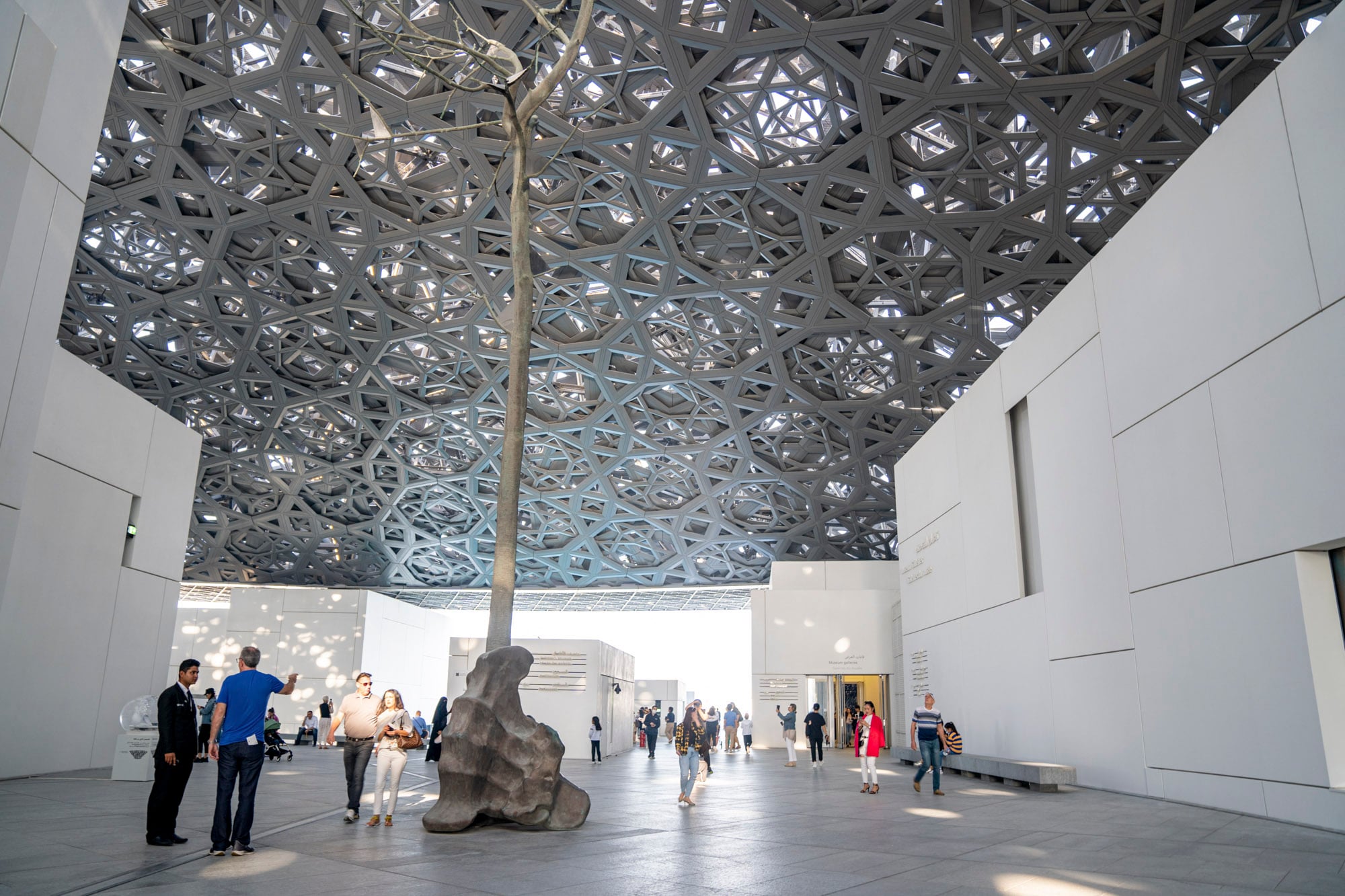
Shade reaches visitors at the Louvre Abu Dhabi well before any painting does. Beneath the dome on a clear afternoon, the white paving is scattered with coins of sunlight that slide across the stone as the hour moves on. Nouvel calls the effect a “rain of light”. He took the idea from the broken shade of overlapping palm fronds, familiar to anyone who has sat in an Emirati garden.
The dome measures 180 metres across and rests on four piers set 110 metres apart, so discreetly placed that the roof seems to hover 36 metres above the ground. Its 7,850 stars repeat at different sizes and angles through eight layers, four of stainless steel outside and four of aluminium within. Much of the cladding was assembled at a plant in Musaffah, on the industrial edge of Abu Dhabi, where workers clipped aluminium profiles into the star-shaped panels.
Beneath it Nouvel laid out a museum city in the sea. Its 55 white buildings, 23 of them galleries, are cast in ultra-high-performance concrete and arranged like a low medina, with water running between the blocks. Visitors may arrive by road or by boat. The studio worked on the scheme from 2006 until the opening in November 2017. Nouvel’s team also handled the interiors and the display, and he designed seating with Poltrona Frau in ribbed black leather whose long curves follow the profile of the dome. “Architecture does not stop at the front door,” he remarked when the pieces were shown in Milan.
One New Change, London
Nouvel’s first permanent building in Britain opened beside St Paul’s Cathedral in 2010. It is a shopping and office block, yet public passages cut through the site, and a lift carries visitors to a roof terrace with a view of Wren’s dome that few had enjoyed before. Nouvel described the design as deliberately deferential to the cathedral, a notable concession from an architect seldom accused of modesty.
40 Mercer, New York
His first completed building in New York was finished in SoHo in 2007 and holds 40 apartments. Some of the windows slide open at the touch of a button, the largest 11 feet high and 20 feet long, so that a living room can become a loggia above the cobbles. Nouvel’s work extended into the apartments themselves, and residents share a landscaped garden.
53 West 53, New York
Completed beside the Museum of Modern Art in 2019, the tower rises to 1,050 feet and gives three of its lower floors to the museum’s galleries. Its structure is a diagrid of diagonal members carried on the outside of the building. The angled struts appear in the frame of the windows, so the position of an apartment, and the furniture it will take, deserves careful thought. Thierry Despont, not Nouvel, designed the interiors.
One Central Park, Sydney
Developed by Frasers Property and Sekisui House on the site of a former brewery, the two towers carry planting devised with the French botanist Patrick Blanc across roughly half of their façades. The apartments open onto loggias. In Sydney the difficulty was not heat but shadow, so a motorised heliostat fixed to a high cantilever reflects sunlight into the part of the adjoining park the towers would otherwise darken.
A house in the south of France
The most private example belongs to a collector. The Paris dealer Patrick Seguin, best known for championing Jean Prouvé, lives with his collection in a house in the south of France built by Nouvel. The two are long-standing friends, and Nouvel also reworked Seguin’s gallery in the Bastille. People who live closely with design tend to judge a house by its rooms rather than its reputation, and the commission says as much.
Saadiyat Island today
On Saadiyat, a name and an author are easily confused. Aldar’s Louvre Abu Dhabi Residences, launched in 2022, borrow the museum’s name through a partnership with the institution. They are not buildings by Nouvel.
The island’s upper market has moved quickly all the same. In October 2025 Abu Dhabi Sotheby’s International Realty sold a five-bedroom penthouse at Four Seasons Private Residences on Saadiyat Beach for AED 200 million, reported at the time as the highest price paid for an apartment in the capital. The home, of some 1,323 square metres, was bought off plan, with completion scheduled for 2029. That December, Sotheby’s inaugural Abu Dhabi Collectors’ Week, presented with the Abu Dhabi Investment Office, closed with auctions on Saadiyat Beach that realised a combined $133.4 million, with bidders from 35 countries.
No sale can say how much a museum adds to a nearby address. What the dome offers a buyer is a more practical lesson. Its stars were set out so that shade would fall where people stand. On a terrace at four o’clock on a June afternoon, an overhang deep enough to sit beneath shows that someone thought about the sun.
Read More