

What It’s Like Living on Hudayriyat Island
Across the water from Al Bateen, Hudayriyat Island is no longer a quiet stretch of coast, but one of Abu Dhabi’s most closely watched new districts. Its appeal lies in the sheer scale of what is being planned, and in the unusual amount of space given over to beaches, cycling routes, sport, parks and low-density residential communities. Spanning more than 51 million square metres, equivalent to 53.8% of Abu Dhabi Island, the masterplan gives the capital room to grow westwards without losing sight of the sea.
Hudayriyat feels markedly different from Abu Dhabi’s older residential areas. There is no inherited town centre to work around, and no rush to build upwards for the sake of impact. The island is being drawn out along the coastline, with homes, beaches, hospitality, cycle tracks and open spaces arranged as part of the same everyday setting. The plan includes 53.5 kilometres of coastline, 16 kilometres of beaches, elevated hill communities, a 220-kilometre cycling network, Surf Abu Dhabi, Velodrome Abu Dhabi and what is set to become the largest urban park in the emirate.
A Coastal Address with a Different Rhythm
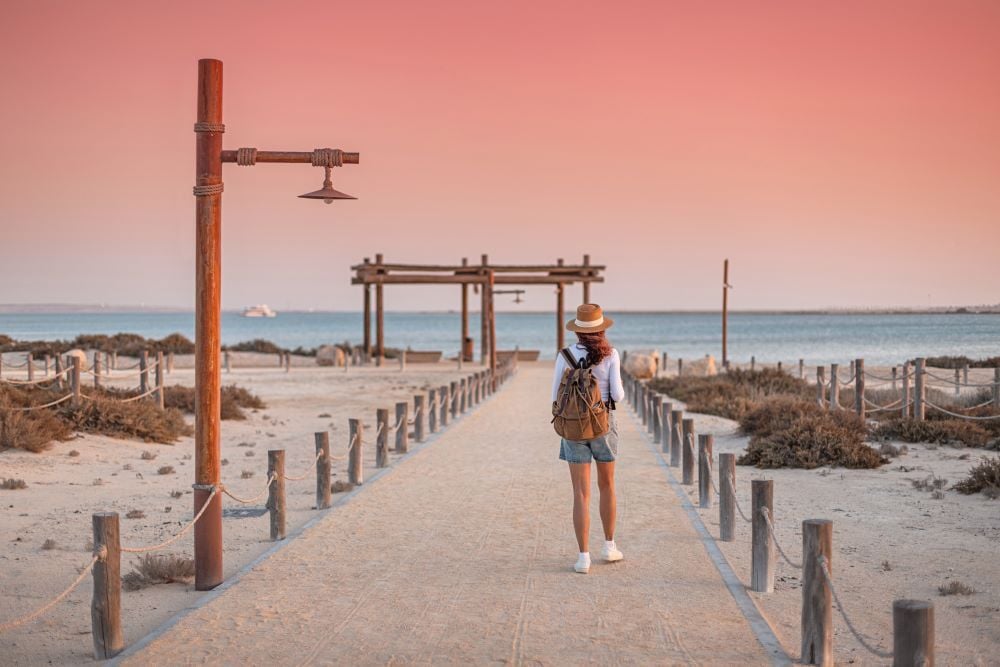
Hudayriyat makes its point quietly at first. There is more sky, more shoreline and a greater sense of breathing room than in Abu Dhabi’s busier waterfront districts. The island is still taking shape, but that is part of its appeal. It has room to grow properly, with homes, parks, promenades and beach access being planned together.
For residents, much of the appeal lies in the ease of living closer to the water, where a morning run, a cycle before the heat builds, or a walk along the shore can become part of the routine. By evening, beachside dining and open-air spaces give the island a livelier edge.
Housing and Residential Character
Hudayriyat’s homes are being planned with breadth rather than height in mind. The island’s residential mix leans towards villas, townhouses, low-rise apartments and elevated neighbourhoods, giving it a more open character than Abu Dhabi’s denser waterfront districts.
Bashayer, launched by Modon in December 2025, is Hudayriyat’s first waterfront community, with 157 luxury villas and 330 apartments, including penthouses, overlooking Al Bateen Beach and the Abu Dhabi skyline. Its villas range from four to five bedrooms, starting from AED 7.2 million, with handover scheduled for Q1 2029.
Nawayef adds a more dramatic setting. Its East Hill rises 60 metres, with four- to eight-bedroom residences divided across Homes, Heights and Mansions collections, starting from AED 6.6 million. Nawayef Village offers three- to five-bedroom townhouses and twin villas from AED 4.1 million, while Nawayef Park Views introduces the island’s first freehold apartments, bringing one- to four-bedroom homes close to retail, dining, parks and community amenities.
Beaches, Sport and Open-air Living
A large part of Hudayriyat’s appeal lies in the open air. Marsana, Hudayriyat Beach, Bab Al Nojoum, 321 Sports, Circuit X, Trail X and the island’s cycling tracks already give the place a rhythm beyond its residential plans. Experience Abu Dhabi presents it as a destination for outdoor enthusiasts, sports lovers and active families, with beaches, water sports and adventure facilities forming a large part of the appeal.
The masterplan takes that further, folding these existing attractions into a wider island setting that will include Surf Abu Dhabi, Velodrome Abu Dhabi and a 2.25 million-square-metre urban park. Marsana keeps things grounded in everyday use, with its sandy beach, Splash Park, children’s play area, pool, outdoor gym, cycle paths and marina viewing pier.
It is this mix that gives Hudayriyat a clearer sense of place as its residential communities mature. Serious training, family days out and quieter walks by the water can all sit naturally within the same coastal setting.
History and Sense of Place
Hudayriyat is often described through what is coming next: new homes, beaches, sports facilities and large-scale infrastructure. But the island also has a documented archaeological layer. The Hudayriyat Heritage Trail was established to protect remains found on the island, including shell middens associated with pearl fishermen who once lived there. The discovery of dugong and shark remains also shows how closely earlier communities depended on the sea for food and daily life.
This adds useful context to the island’s present development. Hudayriyat’s coastline is now being planned around villas, beach access, sport and leisure, yet its older history was coastal in a more practical sense, shaped by fishing, pearling and the marine resources of the Arabian Gulf. It may be emerging as a new residential district, but it is being built on land with its own record of settlement, work and life by the water.
Dining, Leisure and Community Life
Hudayriyat already has a well-defined social focus, with Marsana serving as its main waterfront gathering point. Its beachfront restaurants, cafés, family areas and marina setting give the island a place to spend time, rather than simply pass through for sport or a walk by the water. As the residential communities are delivered, that social life is likely to become more local. What is now largely a weekend destination for beachside meals and family outings should gradually become part of everyday life, shaped by residents returning to the same cafés, using the promenade and dining by the water without leaving the island.
This direction can already be seen across the island’s residential plans. Nawayef Village is one of the clearer examples, with Modon outlining retail, dining, community facilities, parks, pools, schools and medical services as part of the wider neighbourhood offer. The intention is not only to introduce new homes, but to support the kind of daily use that allows a residential community to take hold.
Education, Healthcare and Daily Convenience
Hudayriyat’s residential planning follows a similarly measured approach. The island is being developed with schools, healthcare, parks and a wider network of community infrastructure, though much of this is being introduced in phases alongside its housing. Nawayef Village offers a clear indication of that direction, with schools and medical facilities included within its planned amenity mix, while the wider masterplan sets these communities within a broader framework of residential neighbourhoods, leisure, retail, beaches and open space.
For early residents, this means the island already offers a strong lifestyle setting, with everyday conveniences continuing to develop as each phase is completed. Access to schools, healthcare and retail will become more immediate, shaping a more settled residential environment. Hudayriyat’s long-term position is clear, but it is still in the process of taking shape as a fully established neighbourhood.
Investment Appeal
The market has already put numbers behind Hudayriyat’s promise. In Q1 2026, figures released by the Abu Dhabi Real Estate Centre showed AED 66 billion in real estate transactions across the emirate, with Hudayriyat Island leading all areas by transaction value at approximately AED 11.97 billion. For a district still moving through its early residential phases, ranking ahead of Reem Island and Saadiyat Island in the same quarter is a notable signal of buyer confidence.
Modon’s sales results tell a similar story at project level. Bashayer, Hudayriyat’s first waterfront residential community, sold out within one day of launch, generating AED 3 billion from 157 villas and 330 apartments. Nawayef Village also sold out on launch day, with 378 townhouses and twin villas generating approximately AED 2 billion. Buyers are clearly not waiting for the island to be fully settled before taking a position.
For investors, much of the appeal lies in timing. Hudayriyat is still early enough in its development to offer entry into a major coastal district as it takes shape, yet far enough along to show strong demand and a clear direction of travel. Its value will rest on the continued delivery of its homes, public realm, leisure infrastructure, schools, retail and community facilities. Even so, the early figures suggest the island has already moved from long-term promise to one of Abu Dhabi’s keenly observed residential markets.