

Why Investors Are Still Backing Ras Al Khaimah's Long-Term Growth Story
Ras Al Khaimah's property market has shown notable resilience over the past six months, weathering a period of regional uncertainty without any meaningful loss of value. While the pace of transactions has moderated somewhat as buyers take a more considered approach, the underlying fundamentals of the market, and the emirate's long-term investment case, remain intact.
Recent market data illustrates the point clearly. Between October and March, residential sales prices across the emirate rose by close to 5 per cent for apartments and nearly 4 per cent for villas, with rental rates climbing at a similar pace. Ready apartments were changing hands at just over Dh1,200 per square foot in the first quarter of the year, with ready villas priced at around Dh1,000 per square foot. Across 2025, the emirate's residential sector recorded Dh12.3 billion in total sales across roughly 6,600 transactions, with off-plan activity accounting for the significant majority of deals, a sign that buyers continue to commit capital to the emirate's growth story even as headlines elsewhere in the region have created short-term caution.
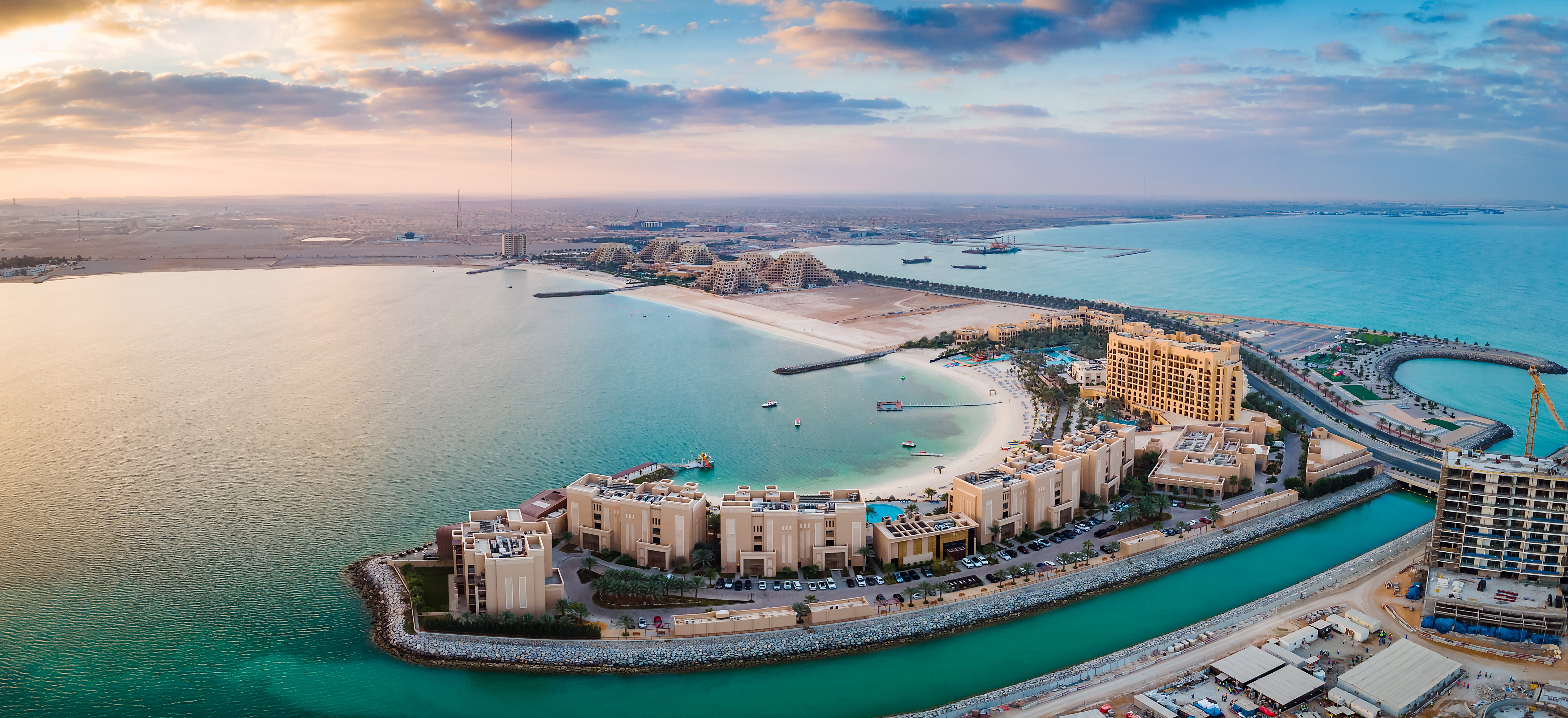
Al Marjan Island at the Centre of Growth
No single location captures Ras Al Khaimah's momentum quite like Al Marjan Island, which now accounts for more than half of all residential sales listings in the emirate. Foreign buyers make up the majority of purchasers there, drawn by a combination of waterfront living, strong yields relative to other Gulf waterfront destinations, and the prospect of significant infrastructure still to come.
Chief among the developments underpinning that confidence is Wynn Al Marjan Island, a $5.1 billion integrated resort due to open in early 2027. Christopher Cina, Managing Director and Head of Project Developments for UAE markets at Sotheby's International Realty, points to the emirate's broader appeal as the real driver behind sustained demand.
"Ras Al Khaimah has never been a singular destination," Cina explains. Beach, mountain and desert sit side by side, he notes, each drawing its own audience, and that range, paired with the Wynn resort and RAK's proximity to Dubai, gives the emirate an offering that is genuinely distinct within the wider region.
Tourism and Infrastructure Reinforce the Case
That distinctiveness is already translating into visitor numbers. Ras Al Khaimah welcomed more than 670,000 tourists in the first half of the year, its strongest half-year on record, with domestic arrivals up 47 per cent. Cina points to this as evidence that tourism momentum has continued uninterrupted through the period of regional volatility, rather than slowing in step with it.
Commercial development is following a similar trajectory. RAK Central, the business district taking shape around Al Marjan Island, is set to deliver three million square feet of Grade A office space, more than 4,000 homes and three hotels, with every plot released to date sold within fifteen months. Cina highlights this as a meaningful signal in itself: the emirate is not simply building a leisure destination, but a resident, working population alongside it, which lends the market a depth that purely tourism-driven locations often lack.
The pipeline supporting this growth is substantial, with more than 25,000 new residential units in development across the emirate through to 2030. Planned road upgrades are expected to cut journey times to Dubai significantly, while Ras Al Khaimah International Airport is targeting three million annual passengers within the next two years, further strengthening the emirate's connectivity to the wider region.
A Market Built for the Long Term
Taken together, these factors point to a market that has absorbed short-term regional uncertainty without any structural disruption. Real estate transactions in the UAE remain predominantly cash-driven, a feature that has historically insulated physical property values from the kind of volatility seen in listed markets during periods of geopolitical tension. For Ras Al Khaimah specifically, the coming months look set to form what many in the industry are describing as a consolidation phase ahead of the Wynn resort's opening, one in which rental yields have room to catch up with the capital appreciation already seen across the emirate.
For buyers with a genuine long-term outlook, that combination of steady fundamentals, a deep development pipeline and a diversifying economy continues to make Ras Al Khaimah one of the more compelling investment cases in the UAE. As Cina puts it, the emirate's advantages, infrastructure, connectivity and a range of landscape and lifestyle offerings found nowhere else in the region, are not the kind of thing that regional headlines can easily unsettle.
Read More